
How AI Image Generation Has Changed in 2026

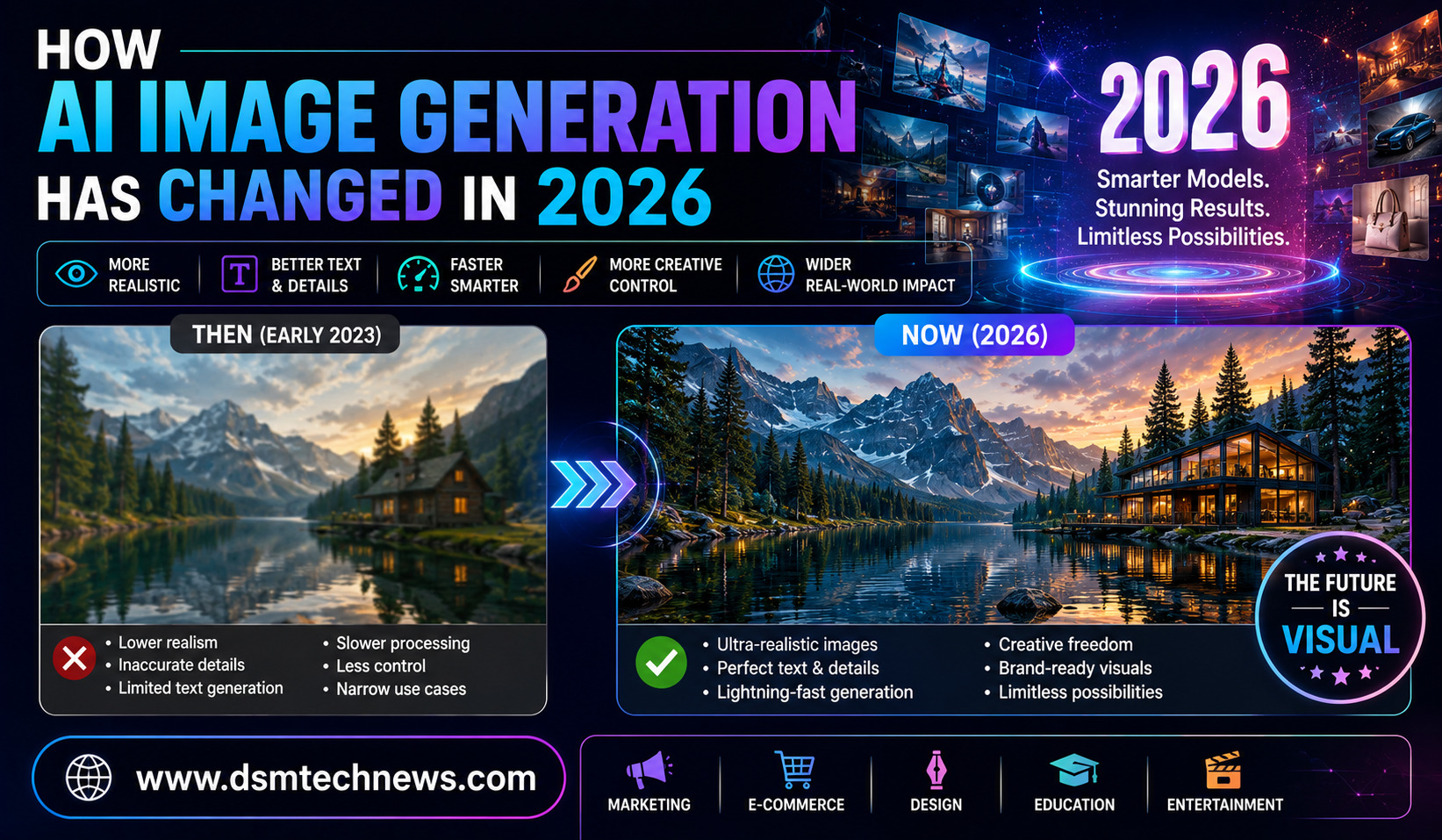
AI image generation has changed dramatically in 2026. What once felt like a futuristic experiment has become a practical creative tool used by bloggers, marketers, businesses, designers, e-commerce brands, social media creators, and everyday users. The biggest change is not simply that AI images look more realistic. The technology has become better at understanding instructions, editing existing images, maintaining consistency, rendering readable text, and producing visuals that are actually useful for professional work.
In earlier generations, creating a good AI image often meant writing extremely detailed prompts and accepting several imperfect results before finding something usable. In 2026, the process is becoming much more conversational. Users can describe what they want, make corrections, upload reference images, and ask the AI to refine specific elements without starting completely from scratch.
From Prompt Experiments to Creative Workflows
One of the biggest changes in AI image generation in 2026 is the move away from simple text-to-image generation. Instead of treating an AI image generator as a machine that produces one picture from one prompt, users increasingly treat it as a creative assistant.
Modern systems can understand longer instructions and handle several requirements at once. A user can describe the subject, environment, composition, lighting, mood, camera perspective, typography, and branding requirements in a single conversation.
OpenAI’s GPT Image 2, for example, is designed for image generation and editing with flexible image sizes and high-fidelity image inputs. Google has similarly improved Gemini’s image capabilities with stronger instruction following, local editing, character consistency, and better text rendering.
This means creators spend less time learning complicated prompt formulas and more time explaining their creative idea.
AI Has Become Much Better at Editing Images
AI image editing has arguably become more important than generating completely new pictures.
In the past, changing a generated image could be frustrating. A request such as changing a person’s clothing might accidentally alter the face, background, pose, or lighting. Maintaining the important parts of an image while changing only one element was difficult.
In 2026, image models are becoming much better at localized editing. Users can upload an existing photograph and request specific modifications while preserving much of the original composition.
This has major implications for bloggers, photographers, marketers, and online sellers. A product image can be placed in a different environment, a background can be changed, unwanted objects can be removed, and visual details can be refined without recreating the entire image.
ChatGPT Images supports both new image creation and editing of uploaded images, including requests to add details, add text, or create transparent backgrounds.
The result is a workflow that increasingly resembles having an AI-powered editing assistant rather than simply using a traditional image generator.
Character Consistency Is No Longer as Difficult
Keeping the same character consistent across multiple images has been one of the biggest challenges in generative AI.
Previously, generating a character in one image and then asking for the same character in another scene could produce completely different facial features, clothing, body proportions, or hairstyles. This made AI-generated comics, children’s books, advertisements, storyboards, and campaigns difficult to produce reliably.
That situation has improved considerably in 2026.
Google’s current Gemini image tools specifically highlight character consistency, allowing the appearance of people or characters to remain more stable across generated images and enabling multiple reference images to be combined.
This development is important because professional visual storytelling depends on continuity. A character should look like the same person whether they appear in a bedroom, office, street, classroom, or outdoor environment.
AI is not perfect yet, but consistency has become a much more practical part of the generation process.
Text Inside Images Has Improved
For years, one of the most obvious weaknesses of AI image generators was text.
A model could create an impressive poster but produce misspelled words, strange letters, or unreadable headlines. This made AI-generated images less useful for advertisements, infographics, posters, thumbnails, menus, and social media graphics.
In 2026, text rendering has become a much stronger capability.
Modern image models are increasingly capable of producing readable headlines, labels, signs, captions, and other text elements. Google’s Gemini image documentation highlights improved text rendering and more accurate spelling across supported languages. OpenAI has also emphasized stronger text and layout capabilities in its newer image-generation systems.
This does not mean every generated image will contain perfect typography. Designers may still need to check important text carefully. However, the improvement makes AI much more useful for practical design work.
Realistic Images Have Become Harder to Distinguish
Photorealism has also continued to improve.
AI-generated people, products, interiors, food, landscapes, and lifestyle scenes can now contain much more convincing lighting, materials, reflections, shadows, textures, and compositions.
The important shift is that realism is no longer the only measure of quality. Once AI can produce a realistic-looking photograph, other factors become more important: Does the image follow the instructions? Is the person’s appearance consistent? Is the text correct? Can the image be edited without destroying the composition? Can a business use it efficiently?
This is why AI image generation in 2026 is increasingly competing on usefulness rather than visual novelty alone.
Reference Images Have Become More Important
Another major development is the growing role of reference images.
Instead of describing everything from scratch, users can provide an existing photograph, product image, character design, logo, mood reference, or several visual examples. The AI can then use those references to create a new image or modify the existing material.
This is particularly valuable for businesses.
An e-commerce company, for example, may have a photograph of a product but want several marketing scenes around it. A fashion brand may want the same product shown in different environments. A blogger may want a consistent visual identity across multiple articles.
Reference-based generation reduces the gap between an idea and a usable visual asset.
AI Image Generation Is Becoming More Personalized
AI is also moving toward personalized image creation.
Google has introduced features that can use connected personal context, such as Google Photos, to create more personalized images for eligible users.
This represents a broader direction for generative AI. Instead of asking a model to create a generic person, house, room, or vacation scene, users can increasingly provide personal context and receive something that feels tailored to them.
Personalization could become especially important for advertising, social content, invitations, educational materials, and digital experiences.
At the same time, this development makes privacy and consent increasingly important. Users should understand what personal information an AI system can access before enabling connected services.
AI Image Generation Is Becoming a Business Tool
In the early days, AI image generators were primarily associated with experimentation and entertainment. In 2026, businesses are using them for practical production.
Marketing teams can create campaign concepts faster. Bloggers can produce featured images without hiring a designer for every article. E-commerce sellers can experiment with product backgrounds and lifestyle scenes. Startups can create early branding concepts without building a complete design team.
The technology is also becoming easier to integrate into software. OpenAI’s image-generation API, for example, has enabled businesses and developers to incorporate image generation directly into their own products and workflows.
This changes AI image generation from a standalone website feature into something that can operate behind the scenes inside business applications.
Prompt Engineering Is Becoming Less Important
Another interesting change is the declining importance of complicated prompt engineering.
Detailed prompts are still useful, especially for professional projects. However, users increasingly do not need to memorize special structures or hundreds of keywords.
Modern models are better at understanding natural language. Instead of writing a rigid technical prompt, someone can explain an idea conversationally and then make adjustments.
For example, a creator can start with a simple concept and then say that the lighting should be warmer, the subject should move to the left, the background should look more premium, or the image should have space for a headline.
This makes AI image generation accessible to people who have no professional design or prompt-writing background.
The Human Creative Role Has Not Disappeared
Despite these advances, AI has not eliminated the need for human creativity.
A generated image can be technically impressive while still being unsuitable for a particular audience or brand. Human judgment remains important for choosing concepts, checking accuracy, maintaining brand identity, reviewing cultural context, and deciding whether an image communicates the intended message.
The industry itself is increasingly discussing AI as a creative assistant rather than a complete replacement for photographers and designers. Recent comments from Skylum, for example, emphasized using AI to remove repetitive technical work while preserving creative control and personal style.
The most effective workflow is therefore likely to combine AI speed with human direction.
What the Future of AI Image Generation Looks Like
The changes seen in 2026 suggest that AI image generation is moving toward a more intelligent and interactive creative experience.
The future is unlikely to be defined only by who can create the most photorealistic picture. Instead, successful image systems will need to understand context, maintain consistency, edit accurately, handle text, work with references, follow complex instructions, and fit naturally into professional workflows.
For creators, this means the barrier to producing high-quality visual content is becoming much lower. A blogger with a laptop can create custom article graphics. A small business can experiment with advertising concepts. An online seller can produce multiple product scenes. A social media creator can develop a consistent visual style without a traditional studio.
AI image generation in 2026 has therefore moved beyond the novelty of creating pictures from words. It is becoming a complete visual production tool.
The biggest transformation is not that AI can make images faster. It is that AI is increasingly able to understand what users mean, respond to feedback, preserve important details, and help turn an idea into a finished visual asset. As these systems continue to improve, the boundary between image generation, image editing, design, and creative collaboration will become increasingly difficult to separate.
AI image generation has changed dramatically in 2026. What once felt like a futuristic experiment has become a practical creative tool used by bloggers, marketers,…