Adobe Firefly vs ChatGPT vs Gemini for Commercial Images

AI-generated images are becoming an important part of modern marketing. Businesses can now create website banners, social media graphics, product visuals, advertising concepts, blog images, promotional artwork, and other creative assets without organizing a full photography or design project.
But when an image is going to be used commercially, visual quality is only part of the decision. Businesses also need to think about licensing, intellectual property, editing capabilities, brand consistency, privacy, and how much control they have over the final image.
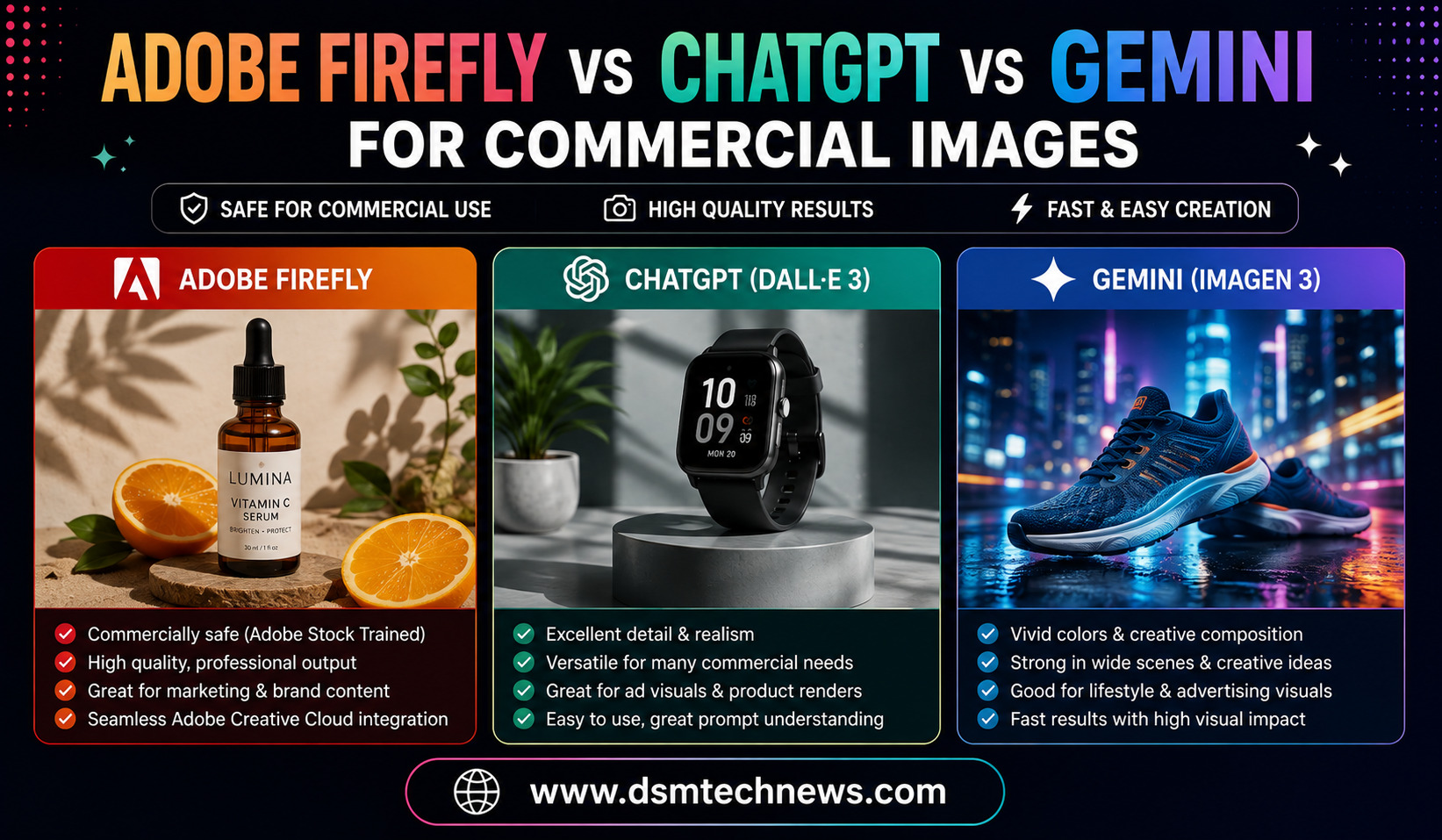
Three popular options are Adobe Firefly, ChatGPT, and Gemini. All three can generate and edit images, but they are designed around somewhat different workflows.
Adobe places particular emphasis on commercially safe creative AI and integration with professional design tools. ChatGPT focuses heavily on conversational generation and editing, while Gemini combines image creation with Google’s broader AI ecosystem and reference-based workflows.
So, which one is best for commercial images?
What Makes Commercial AI Images Different?
Creating an image for personal use is relatively simple. Creating an image for a business campaign is more complicated.
A company may use an AI-generated image on its website, product packaging, advertisement, social media campaign, blog, brochure, or paid promotion. In these situations, the business needs to understand whether the relevant tool and output can be used commercially under the applicable terms.
This is why choosing an AI image generator should not be based only on which platform creates the prettiest image.
Adobe explicitly positions Firefly’s own AI models as commercially safe and says they are trained on licensed content and public-domain content where copyright has expired. Adobe also says Firefly-generated outputs can be used commercially, subject to its terms and applicable product restrictions.
For ChatGPT and Gemini, users should review the applicable terms and policies for the specific service and plan they are using. Google also warns Gemini users to consider copyright and privacy rights before relying on, publishing, or using generated content.
Adobe Firefly: Built With Commercial Creative Work in Mind
Adobe Firefly is perhaps the most obvious choice when commercial production is the primary concern.
Adobe designed Firefly as a family of generative AI models for creative workflows and says its models are trained on licensed content, including Adobe Stock, along with public-domain content where copyright has expired. Adobe also says it does not train Firefly on customer content.
This approach is important for businesses that want a clearer commercial-AI workflow.
Adobe says Firefly outputs can be used commercially and describes Firefly as commercially safe. Eligible enterprise customers may also receive IP indemnification for selected Firefly outputs, subject to the applicable offer and terms.
Another major advantage is the Adobe ecosystem. Firefly is integrated into products such as Photoshop and Illustrator, allowing businesses to combine AI generation with traditional creative tools.
That means a designer can generate a concept with Firefly and then continue refining it inside a familiar professional workflow.
For businesses already using Adobe Creative Cloud, this integration can be a major advantage.
ChatGPT: Flexible Commercial Image Creation
ChatGPT takes a more conversational approach to image generation.
Instead of treating image creation as a separate design process, you can describe the visual you want, generate it, inspect the result, and then request specific changes.
ChatGPT Images can also edit existing images. OpenAI’s current documentation says users can upload an image and describe the changes they want, while the system can generate new images, add details and text, and make backgrounds transparent.
This makes ChatGPT particularly useful for marketing teams and content creators who need to experiment quickly.
For example, you could start with a product photograph and ask for a clean studio background. After reviewing the result, you could ask for softer lighting, a different composition, or more empty space for advertising copy.
The conversational workflow reduces the need to repeatedly recreate a prompt from scratch.
OpenAI’s business terms state that, between OpenAI and the customer, the customer retains ownership rights in inputs and owns output, to the extent permitted by applicable law. The terms also make the customer responsible for having the necessary rights and permissions for inputs and for evaluating the output’s suitability.
For businesses, that distinction matters. Having rights to an output under the service terms does not mean every generated image is automatically free from third-party legal or trademark concerns.
Gemini: Strong for Image Creation and Editing
Google’s Gemini image tools have also become increasingly capable for commercial content workflows.
Google’s current Gemini documentation says users can generate and refine images with Nano Banana 2, while paid subscribers can access Nano Banana Pro for regeneration. Gemini also supports character consistency across generated images and can combine multiple images to blend scenes or ideas.
This makes Gemini useful when a commercial campaign requires multiple related visuals.
For example, a brand could develop a recurring fictional character and place that character into different marketing environments. Reference-based generation can also help when an existing image needs to be adapted into several creative variations.
However, Google’s guidance is more cautious than Adobe’s specific Firefly commercial-safety positioning. Google tells users that Gemini-generated images are subject to Google’s Terms of Service and Prohibited Use Policy and advises users to consider copyright and privacy rights before relying on, publishing, or using generated content.
For important commercial campaigns, businesses should therefore check the current Google terms applicable to their specific Gemini product, account, and use case.
Adobe Firefly vs ChatGPT for Advertising
Advertising requires more than attractive visuals.
A commercial image needs to match the brand, communicate the intended message, and often work with existing design assets.
Firefly has a major advantage here because it is deeply connected to Adobe’s professional creative ecosystem. A designer can generate an image and then continue working with it in Photoshop, Illustrator, Adobe Express, or other Adobe workflows.
Firefly also provides Content Credentials for transparency in supported workflows, helping indicate how content was created or modified. Adobe says these credentials are part of its broader approach to content provenance.
ChatGPT is particularly useful when the creative team wants to explore ideas through conversation.
For example, instead of manually changing a design through several applications, a marketer can describe the desired changes directly and iterate on the image.
For rapid creative experimentation, this can be extremely convenient.
Adobe Firefly vs Gemini for Business Images
Firefly’s biggest advantage is its explicit focus on commercially safe creative generation and professional design workflows.
Gemini’s strength is its broader AI ecosystem and increasingly capable image-generation and editing features.
If your business already relies heavily on Adobe products, Firefly can provide a more integrated workflow.
If you are looking for a conversational AI assistant that can generate images, edit uploaded photographs, and help develop visual ideas alongside other tasks, Gemini can be attractive.
The best choice depends heavily on the type of business and the creative workflow.
Which Is Best for Product Photography?
AI product photography is becoming increasingly popular among online sellers.
A seller might upload a basic product photograph and ask an AI tool to remove the background, create a studio setting, or place the product into a lifestyle environment.
Firefly is well suited to this workflow because Adobe provides both generative tools and traditional image-editing software. A generated background can be refined further in Photoshop, giving designers greater control over the final result.
ChatGPT is useful when you want to make these changes through conversational instructions. You can upload an existing product image and describe the environment you want to create around it.
Gemini can also generate and refine images and is particularly interesting when reference images are part of the workflow.
For e-commerce, however, accuracy should always come first. AI should not change a product’s actual color, dimensions, features, packaging, logo, or physical design in a way that could mislead customers.
Which Is Best for Social Media Marketing?
Social media requires a large volume of visual content.
A business might need promotional images for product launches, seasonal campaigns, educational posts, announcements, and advertisements.
ChatGPT can be convenient for rapidly developing multiple creative concepts through conversation.
Gemini can be useful for generating and refining different variations of a visual idea.
Firefly has a strong advantage for teams that want to connect AI-generated visuals with Adobe’s broader marketing and design ecosystem. Adobe says Firefly is integrated with Adobe Express and Adobe GenStudio for creating and activating content at scale.
For a small business owner who does everything independently, ease of use may matter more than deep workflow integration. For a professional design team, integration can become much more important.
Which Is Best for Brand Consistency?
Brand consistency is critical for commercial content.
A company’s marketing images need to maintain recognizable colors, visual language, product appearance, and overall design quality.
Firefly has an advantage for Adobe-based teams because it can work alongside established creative workflows.
ChatGPT can be useful for iterative image editing because you can continue refining a visual through natural-language instructions.
Gemini’s reference-based capabilities can be useful when a campaign involves recurring characters or related visual concepts. Google’s documentation specifically highlights character consistency across generated images.
No matter which platform you choose, businesses should establish a consistent visual direction before generating dozens of assets.
Commercial Safety and Copyright
This is arguably the most important part of the comparison.
Adobe makes a particularly strong commercial-safety commitment for its Firefly models. It says Firefly is trained on licensed and public-domain content and is designed to prevent the generation of content that infringes copyright or intellectual property rights. Adobe also offers IP indemnification for eligible enterprise customers under certain conditions.
ChatGPT’s business terms state that customers own output as between the customer and OpenAI, subject to applicable law, while also making users responsible for their inputs and use of outputs.
Google’s Gemini guidance tells users to comply with Google’s terms and avoid violating the copyright or privacy rights of others.
This means commercial permission and legal safety are not exactly the same thing.
Even when a platform permits commercial use, a business should still check trademarks, recognizable people, copyrighted characters, logos, source images, and other third-party rights before publishing an important campaign.
What About AI-Generated Text and Logos?
Commercial images often need text, product names, headlines, or branding.
AI image generators have improved significantly at handling text, but businesses should still inspect every generated image carefully.
A misspelled word, distorted logo, or incorrect product label can make an advertisement unusable.
For important branding work, it is often better to generate the visual background or concept with AI and add the final typography and official logo using professional design software.
This is another area where Firefly’s integration with Adobe’s creative tools can be valuable.
Which AI Image Generator Should Businesses Choose?
If commercial safety, professional design workflows, and Adobe integration are the biggest priorities, Adobe Firefly is the strongest overall choice.
If conversational image creation, editing, and rapid creative iteration matter most, ChatGPT is a highly practical option.
If image generation, reference-based editing, and character consistency are important, Gemini deserves serious consideration.
There is also nothing wrong with using more than one tool. A creative team might use ChatGPT to brainstorm a concept, Firefly to create a production-ready commercial visual, and another AI tool for experimentation or reference development.
The best workflow is the one that balances visual quality, consistency, legal considerations, speed, and the amount of manual editing required.
Final Verdict
Adobe Firefly vs ChatGPT vs Gemini for commercial images is not simply a competition over which AI creates the most beautiful picture.
Adobe Firefly has the clearest positioning for businesses that want a commercially focused creative-AI workflow, with licensed training data, Adobe integration, Content Credentials, and commercial-use commitments for Firefly outputs.
ChatGPT stands out for flexible conversational image generation and editing. Its ability to work with uploaded images and respond to detailed natural-language instructions makes it particularly useful for marketers, bloggers, and small businesses.
Gemini is a strong option for creators who want image generation and editing combined with reference-based capabilities such as character consistency.
For a business choosing one primary platform, Firefly is the safest starting point when commercial production and Adobe workflows are the priority. For fast creative experimentation and conversational editing, ChatGPT is highly compelling. For reference-driven visual creation and Google’s broader AI ecosystem, Gemini is worth considering.
Whichever platform you choose, don’t treat “commercial use allowed” as a substitute for reviewing the actual image. Check trademarks, likeness rights, copyrighted elements, product accuracy, and the terms that apply to your specific account and workflow before using AI-generated images in important commercial campaigns.
AI-generated images are becoming an important part of modern marketing. Businesses can now create website banners, social media graphics, product visuals, advertising concepts, blog images,…