
Orch8: Durable Workflows for Reliable AI Agents

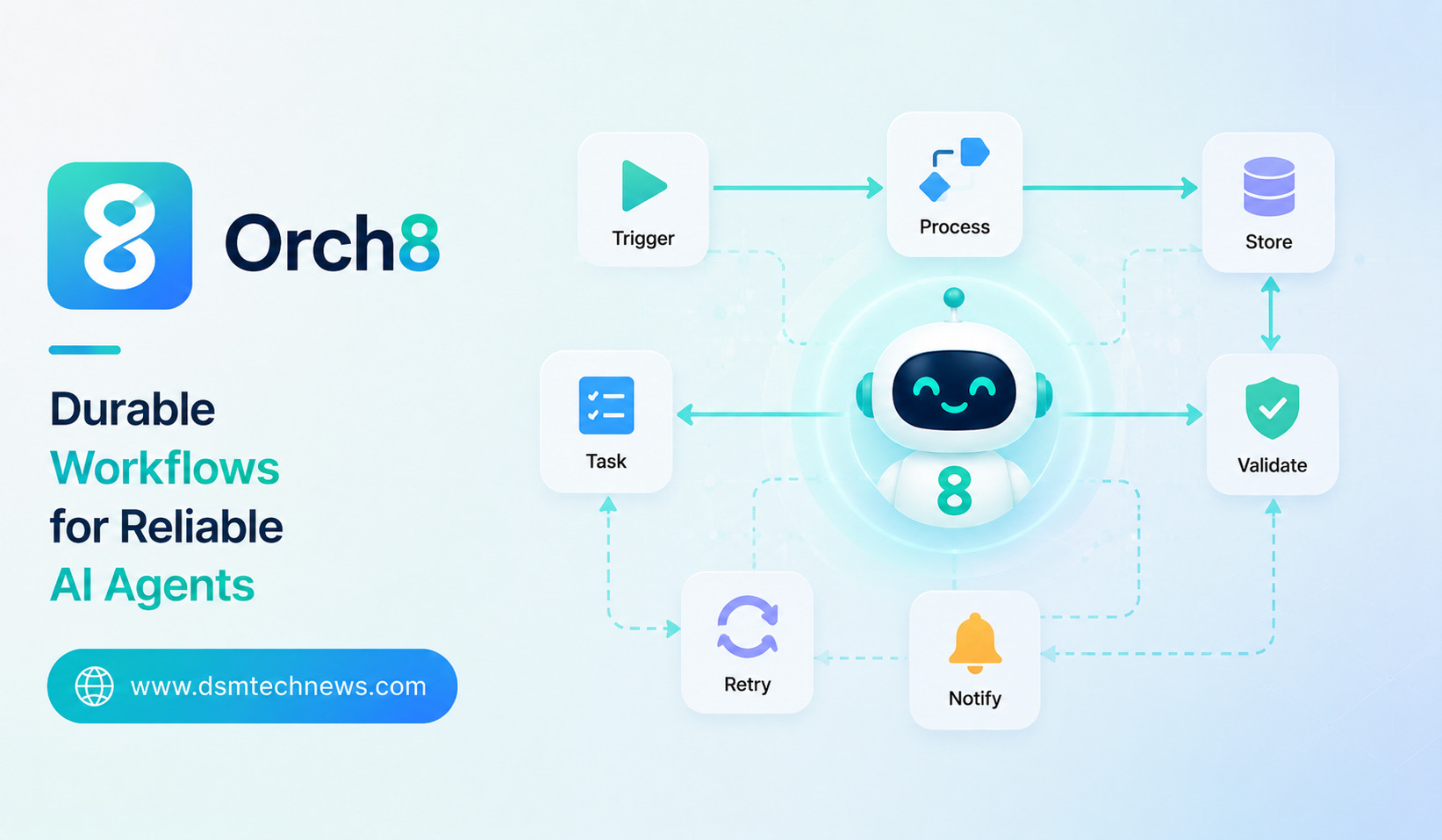
AI agents are moving beyond simple question-and-answer interactions. Modern agents can research information, use software tools, execute multiple steps, interact with APIs, process documents, and complete tasks with limited human intervention.
But giving an AI agent more capabilities also creates a new challenge: reliability.
An agent may need several minutes, hours, or even days to complete a complicated workflow. During that time, an API can fail, a server can restart, a network connection can disappear, or an AI model can return an unexpected result. If the entire workflow depends on one continuous process, a temporary failure can cause the task to stop.
This is where durable workflow technology becomes important. Orch8 represents an approach focused on building reliable workflows for AI agents, helping developers create systems that can continue operating even when individual steps encounter problems.
What Is Orch8?
Orch8 can be understood as a workflow infrastructure concept designed to support durable AI-agent execution.
The word “durable” is important because AI agents often perform tasks that involve multiple stages. A simple chatbot can generate a response in a few seconds, but an autonomous agent may need to perform a sequence such as collecting information, calling an API, analyzing results, generating a document, waiting for approval, and then completing another action.
If something goes wrong halfway through the process, restarting everything from the beginning can waste time and computing resources.
Durable workflows are designed to preserve the state of an ongoing process so that it can continue from an appropriate point instead of starting over.
Why AI Agents Need Reliable Workflows
AI agents are inherently more complicated than traditional software scripts.
A traditional program may follow a predictable sequence of instructions. An AI agent, on the other hand, can make decisions based on the information it receives.
For example, an agent might decide which tool to use, determine what information is missing, call an external service, interpret the result, and then decide what action should happen next.
Every additional step introduces another potential failure point.
An external API might be unavailable. A database could respond slowly. A model might produce an invalid tool call. Authentication could expire. A process might be interrupted before the final action is completed.
A reliable workflow layer helps developers design around these possibilities.
What Makes a Workflow Durable?
A durable workflow is designed to remember where it is in a process.
Imagine an AI agent responsible for preparing a business report. It needs to collect sales information, analyze the data, generate a summary, and prepare a final document.
Suppose the agent successfully completes the data collection and analysis but the system crashes while generating the document.
A basic script may need to repeat the entire process.
A durable workflow can preserve completed steps and resume from the appropriate stage.
This approach can make long-running AI processes more resilient.
Orch8 and AI Agent Orchestration
AI-agent orchestration refers to coordinating different actions, tools, models, and processes so that an agent can complete a larger objective.
An agent may need to communicate with several services during a single task.
For example, a customer-service agent could:
- Receive a customer request.
- Retrieve customer information.
- Search an internal knowledge base.
- Analyze the issue.
- Create a response.
- Request human approval for sensitive cases.
- Send the final response.
- Record the interaction.
This is not simply one AI model generating one response. It is a workflow containing multiple dependencies.
A platform such as Orch8 can be valuable when developers need to coordinate these steps reliably.
Handling Failures and Retries
One of the most important features of reliable workflows is failure handling.
Temporary failures are common in distributed software systems. A network request can fail even when the underlying service is healthy. An API can temporarily become unavailable. A rate limit can prevent a request from succeeding immediately.
Instead of treating every failure as a complete workflow failure, developers can design systems that retry appropriate operations.
For AI agents, this is particularly important because workflows may depend on several external services.
A reliable orchestration layer can help developers define what should happen when a particular step fails.
Some actions may be safely retried, while others may require human intervention.
This distinction is critical. Retrying an information request may be harmless, but automatically repeating a financial transaction could create serious problems.
Long-Running AI Tasks
AI agents are increasingly being used for tasks that cannot always be completed instantly.
An agent might monitor information over time, wait for an external event, request approval from a person, or perform scheduled activities.
Traditional short-lived execution environments are not always ideal for these workflows.
Durable execution allows a workflow to remain logically active even when it is waiting.
For example, an agent could prepare a proposal and then pause until a manager approves it. Once approval is received, the workflow can continue with the next stage.
This opens the door to more sophisticated AI applications.
Human-in-the-Loop Workflows
Reliable AI systems do not necessarily need to be completely autonomous.
In many business environments, the best approach is to combine AI automation with human oversight.
An agent can handle routine steps while asking a human to approve important decisions.
For example, an AI system could analyze a customer complaint and prepare a recommended response. Before sending the message, it could pause and request approval from a support manager.
A durable workflow is particularly useful here because the process may need to wait for hours or days before receiving the required input.
Once the human responds, the workflow can resume without losing its previous state.
Benefits of Durable AI Workflows
The biggest advantage is reliability.
Developers can build AI systems that are better prepared for interruptions, temporary failures, and long-running processes.
Another benefit is efficiency. If completed steps do not need to be repeated after every failure, applications can reduce unnecessary computation and API usage.
Durability can also simplify development. Instead of creating custom mechanisms for saving state, retrying operations, tracking progress, and recovering from interruptions, developers can use workflow infrastructure designed around these problems.
This becomes increasingly valuable as AI applications grow more complex.
Orch8 for Developers
Developers building AI agents need to think beyond the model itself.
Choosing a powerful language model is only one part of creating a reliable agent. The surrounding infrastructure determines how the agent interacts with tools, stores state, handles failures, and completes tasks.
A workflow platform can provide an architectural foundation for these requirements.
This can allow developers to focus on the business logic of their agent rather than implementing every reliability feature from scratch.
For startups and small engineering teams, this can be particularly useful because building a complete workflow orchestration system internally can require significant engineering resources.
Common Use Cases
Durable AI-agent workflows can support many applications.
Customer support: Agents can investigate issues, access customer records, prepare responses, and escalate complex cases.
Research automation: Agents can gather information from multiple sources, analyze findings, and produce reports.
Business operations: AI systems can coordinate repetitive workflows involving databases, documents, email, and internal tools.
Software development: Coding agents can perform multi-step tasks such as analyzing a repository, making changes, running tests, and preparing a summary.
Document processing: Agents can extract information, validate it, transform it, and send the results to another system.
The common feature across these use cases is that the task contains multiple steps and may need to survive interruptions.
Reliability Does Not Mean AI Accuracy
An important distinction is that workflow durability does not automatically make an AI agent intelligent or accurate.
A workflow can reliably execute the wrong decision.
For this reason, developers still need to evaluate model quality, tool permissions, validation mechanisms, security, and human oversight.
Durability solves an infrastructure problem: how to make long-running processes continue reliably.
It does not eliminate the need to validate what an AI agent decides to do.
Security and Observability
As AI agents gain the ability to interact with business systems, security becomes increasingly important.
Developers should control which tools an agent can access and what actions it is allowed to perform.
Logging and observability are also essential. Teams need to understand what an agent did, which tools it called, where a workflow failed, and whether a retry occurred.
For business-critical applications, being able to inspect workflow history can make troubleshooting considerably easier.
Reliable AI infrastructure therefore involves more than simply keeping a process running. Developers need visibility into the entire execution lifecycle.
The Future of Durable AI Agents
AI agents are likely to become increasingly capable of performing complex, multi-step tasks.
As these systems move from experimental projects into production environments, reliability will become just as important as model intelligence.
A powerful AI agent that fails whenever an API temporarily becomes unavailable is difficult to trust. Businesses need systems that can recover from predictable failures, preserve progress, and provide clear visibility into what happened.
Durable workflow infrastructure can become an important part of this transition.
Instead of thinking about an AI agent as a chatbot that generates responses, developers can begin treating it as a long-running software process that needs state management, error recovery, permissions, monitoring, and orchestration.
Final Thoughts
Orch8 highlights an important challenge in the development of modern AI agents: reliability.
As agents become capable of performing longer and more complicated tasks, developers need infrastructure that can keep workflows running despite interruptions and temporary failures.
Durable workflows can preserve progress, support retries, manage human approvals, and coordinate multiple steps across different services.
For developers building production-grade AI agents, this type of infrastructure can be just as important as selecting the right AI model.
The future of autonomous AI will not depend only on how intelligent models become. It will also depend on whether the systems surrounding those models can operate reliably in the real world. Durable workflow technology is therefore likely to become an increasingly important foundation for dependable AI-agent applications.
AI agents are moving beyond simple question-and-answer interactions. Modern agents can research information, use software tools, execute multiple steps, interact with APIs, process documents, and…