
From Text-to-Image to Image-to-Image: The New Era of AI Creativity

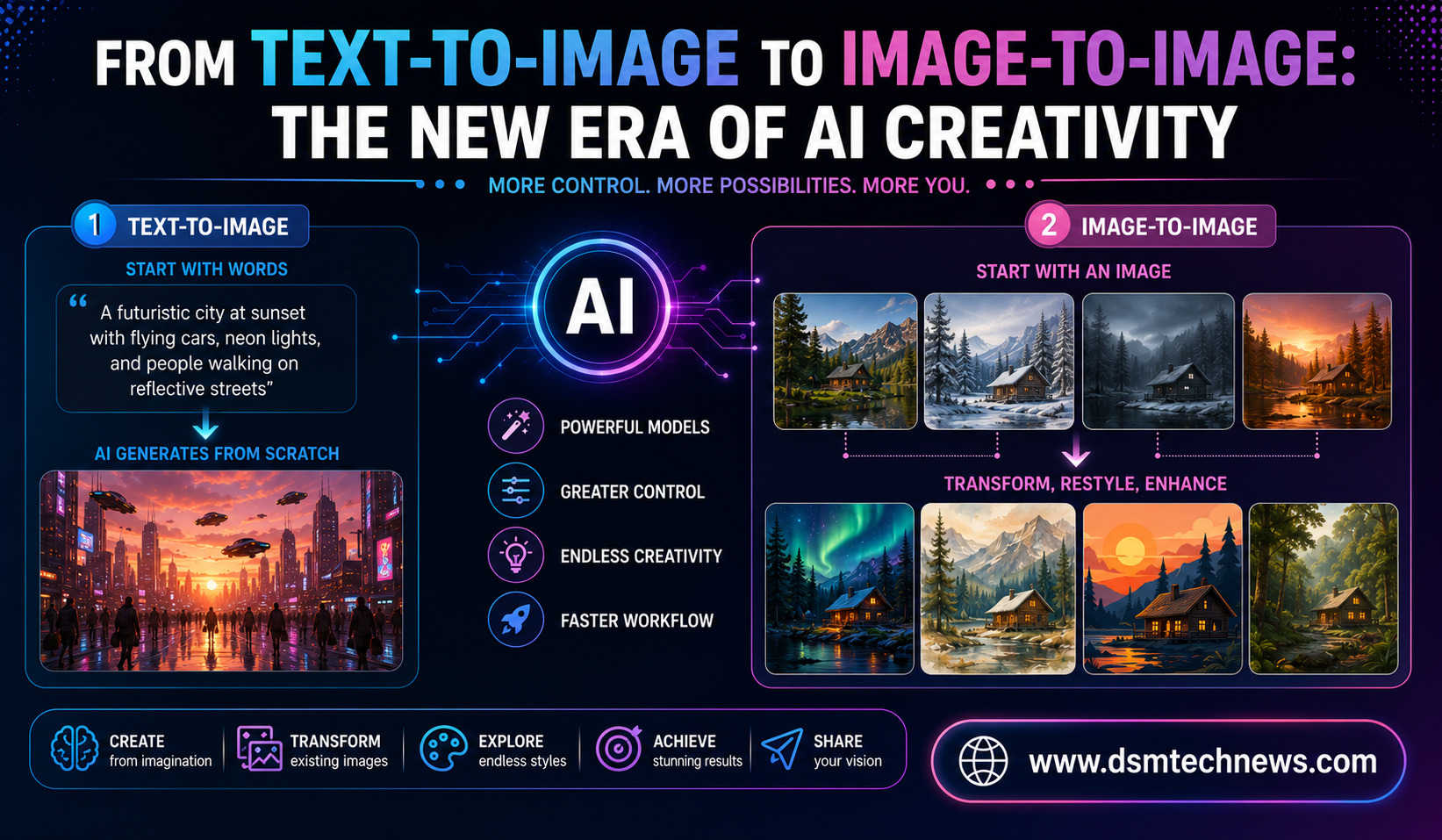
Artificial intelligence has changed the way people create digital images. A few years ago, the main attraction of generative AI was simple: type a description and watch the system turn words into an image. This text-to-image technology opened the door to AI-powered creativity for people who had little or no experience with professional design tools.
In 2026, however, AI image generation has moved beyond simply creating pictures from written prompts. Image-to-image generation, conversational editing, reference images, visual transformation, and multi-image composition are becoming equally important. Instead of starting with a blank screen, creators can now begin with an existing photograph, sketch, product image, character, or design and use AI to transform it.
This shift is creating a new era of AI creativity where humans provide the ideas and visual references while AI handles much of the transformation and production work.
What Is Text-to-Image AI?
Text-to-image AI allows users to create an image by describing what they want in natural language. A prompt might describe a futuristic city, a realistic product photograph, a fantasy landscape, or a professional business illustration.
The technology interprets the words and generates a visual based on the requested subject, style, composition, lighting, and other details.
This approach dramatically reduced the technical barrier to digital art. Someone who could not draw or use Photoshop could suddenly create illustrations, marketing visuals, social media graphics, concept art, and blog images simply by describing an idea.
The technology has continued to improve in 2026, with leading image systems becoming better at understanding complex prompts, producing realistic visuals, rendering text, and following detailed instructions. Recent image-generation tools are increasingly designed around complete creative workflows rather than one-time image creation.
Why Image-to-Image Is the Next Big Step
Text-to-image starts with an idea expressed through words. Image-to-image starts with something visual.
Users can upload an existing photograph, illustration, sketch, or design and tell the AI how they want it changed. Adobe describes image-to-image generation as a technique that transforms one image into another while allowing users to control elements such as style, lighting, colour, texture, and camera angle.
This is a major difference because creators no longer have to explain every visual detail through a prompt.
Imagine having a photograph of a living room and wanting to see it in a modern minimalist style. Instead of describing the entire room, you can provide the photograph and ask the AI to redesign it.
The original image becomes the foundation, while AI handles the transformation.
From Creating From Scratch to Transforming Ideas
The biggest change in AI creativity is the transition from creation to transformation.
Earlier AI image tools were exciting because they could generate something that did not previously exist. Today’s systems are increasingly useful because they can take something that already exists and make it more useful, attractive, consistent, or suitable for another purpose.
A product photograph can become an advertisement. A rough sketch can become a polished concept. A daytime photograph can become a nighttime scene. A basic portrait can be placed in a different environment.
This makes AI image generation particularly useful for businesses and content creators because they often already have visual assets that need modification rather than complete replacement.
Reference Images Give Creators More Control
Reference images have become one of the most important developments in AI image generation.
Instead of relying entirely on written descriptions, creators can show an AI system what they mean. A reference can communicate a person’s appearance, a product’s design, a colour palette, a visual style, a room layout, or a particular composition.
This is especially useful when words cannot fully describe a visual concept.
For example, a fashion brand might provide an image of a specific garment and ask AI to create several lifestyle scenes around it. A blogger could provide a preferred visual style and request new illustrations that follow the same aesthetic.
Modern systems are also becoming better at combining multiple visual references. Meta’s Muse Image, introduced in 2026, is designed to blend multiple photos and allow users to make changes directly on generated images through sketches and annotations.
AI Editing Is Becoming Conversational
Another major change is the way people interact with image-generation systems.
Traditional editing software often requires users to understand layers, masks, selections, brushes, filters, and other controls. AI-powered editing is increasingly allowing people to describe the desired change instead.
A creator can upload an image and say that the background should be replaced with a luxury office, the lighting should become warmer, an unwanted object should disappear, or the clothing should change.
The user can then continue the conversation and request additional modifications.
This conversational approach makes image editing accessible to people who may never have learned professional editing software.
Character Consistency Is Becoming More Practical
AI-generated characters have traditionally suffered from inconsistency. A person created in one image might look noticeably different in the next.
This problem matters for storytelling, advertising, comics, children’s books, games, and social media campaigns.
Image-to-image workflows are helping solve part of this problem because an existing character can be used as a visual reference. Instead of recreating the character from a text description every time, creators can provide an earlier image and ask AI to place the same character in a new situation.
Leading image-generation systems in 2026 are increasingly focused on maintaining visual details across multiple generations. Current tools from major AI companies highlight character consistency, reference-image control, and iterative editing as important capabilities.
AI Image Generation Is Becoming Useful for Businesses
The evolution from text-to-image to image-to-image has significant business implications.
E-commerce companies can create different product environments without conducting multiple photo shoots. Advertising teams can test creative concepts quickly. Real-estate businesses can visualize interior design possibilities. Restaurants can improve food presentation images. Bloggers can transform existing photographs into custom article graphics.
For small businesses, this can reduce the cost and time involved in producing visual content.
Instead of commissioning a new image for every campaign, a company can start with existing assets and use AI to generate variations for different platforms and audiences.
The Rise of AI-Powered Product Photography
Product photography is one area where image-to-image technology can have a particularly strong impact.
A seller may have a basic photograph of a product taken against a simple background. AI can help place that product into a lifestyle setting, create a more polished environment, or produce different visual concepts.
This does not necessarily mean replacing professional photography. Instead, AI can extend the usefulness of existing product assets.
For online sellers, the ability to experiment with different backgrounds and promotional concepts can be extremely valuable. It allows brands to test visual ideas before investing heavily in professional production.
Sketch-to-Image Is Connecting Ideas With Finished Designs
Image-to-image technology also includes workflows where a rough sketch becomes a polished image.
This is particularly useful for designers, architects, game developers, marketers, and students.
A person does not need to create a perfect drawing. A rough layout can communicate the basic composition, while AI can turn that structure into a more detailed visual.
This creates an interesting relationship between human creativity and machine generation. The human controls the concept and structure, while AI helps explore what the finished idea might look like.
Research and emerging tools have also explored systems that combine text prompts with sketches as inputs for AI image generation, demonstrating the growing importance of multimodal creative workflows.
Multiple Images Can Become One Creative Concept
Another major development is AI’s ability to combine different visual references.
A creator might provide a person’s photograph, a background image, a product reference, and a style example. Instead of treating each asset separately, modern AI systems can increasingly understand how these references relate to one another.
Meta’s Muse Image is one example of this direction, with the company describing its ability to reason through layouts and blend multiple visual references.
This opens new possibilities for advertising, storytelling, social media campaigns, and personalized content.
The Role of the Human Creator Is Changing
The rise of image-to-image generation does not mean humans are becoming irrelevant. Instead, the human role is changing.
Creators increasingly act as directors rather than simply image makers. They decide what the image should communicate, which references matter, what should remain unchanged, and what needs to be transformed.
AI can generate variations quickly, but humans still need to choose the strongest concept and check whether the final result makes sense.
This is especially important for commercial content, where accuracy, branding, copyright considerations, and consistency matter.
What Comes Next for AI Creativity?
The future of AI image generation will probably involve an increasingly seamless combination of text, images, sketches, video, and other forms of input.
Instead of choosing between text-to-image and image-to-image, users will increasingly combine both. A creator may start with a photograph, describe a transformation, provide another image as a style reference, sketch a correction, and then ask AI to produce several final versions.
The technology is moving toward a creative conversation rather than a single generation command.
That is the real significance of the shift from text-to-image to image-to-image. AI is no longer simply being asked to invent a picture. It is being asked to understand an existing visual idea, modify it, combine it with other ideas, and help turn it into something new.
Conclusion
AI image generation in 2026 is entering a more mature stage. Text-to-image technology made visual creation accessible to millions of people, but image-to-image generation is making AI more useful for real creative work.
The biggest opportunity lies in the combination of human direction and AI transformation. Creators can bring their photographs, sketches, products, characters, and ideas into the process rather than starting with an empty prompt.
As image models become better at understanding references, preserving important details, following conversational instructions, and making precise edits, AI creativity will become less about generating random images and more about developing complete visual concepts.
The new era of AI creativity is therefore not simply about asking a machine to create an image. It is about giving AI something to work with and using intelligent transformation to take that visual idea much further.
Artificial intelligence has changed the way people create digital images. A few years ago, the main attraction of generative AI was simple: type a description…