
Google Gemini 3.7 Flash: Everything You Need to Know

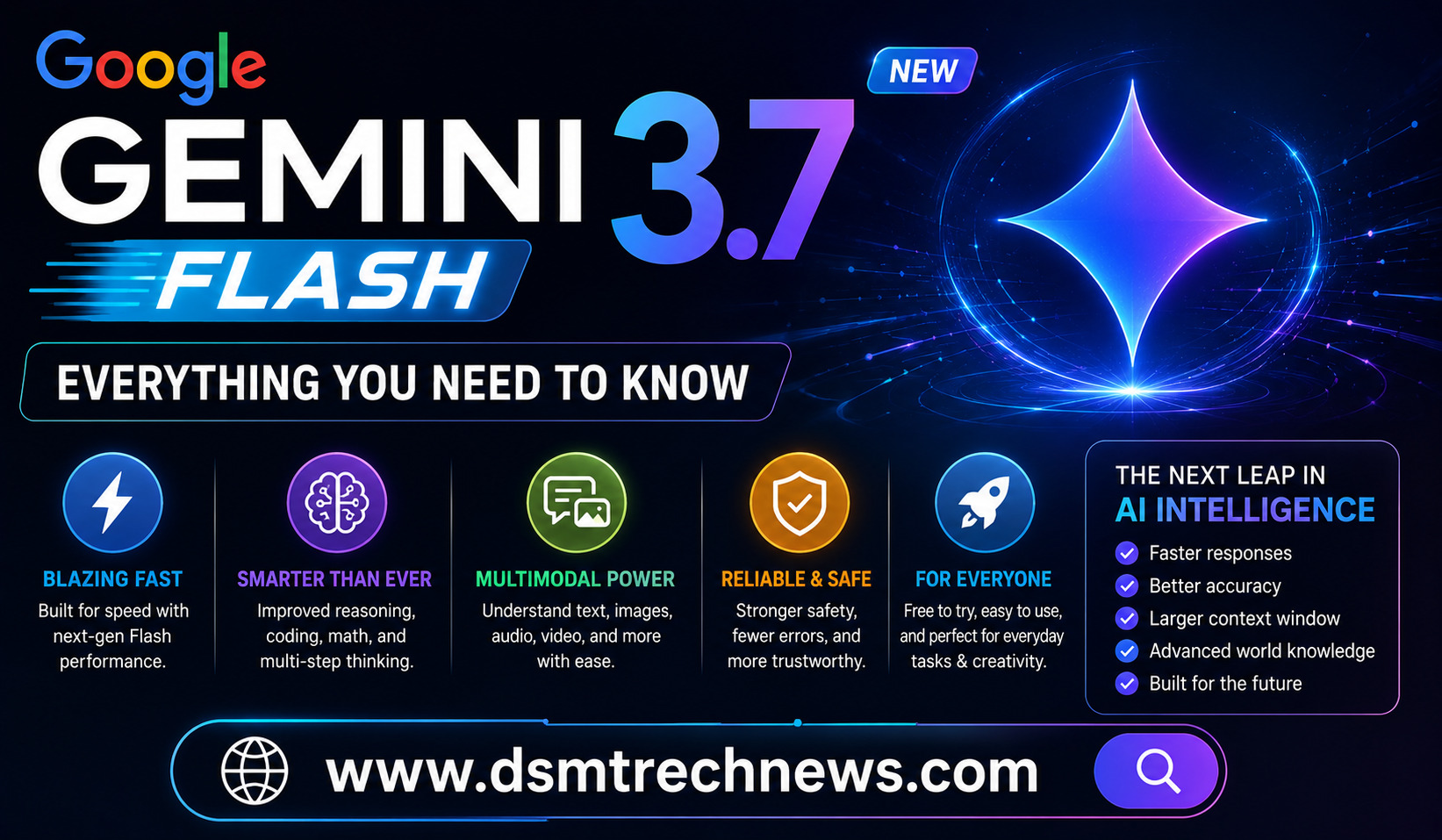
Google has released Gemini 3.7 Flash, its newest Flash-series AI model, and the timing is significant. Arriving on August 13, 2026, only a few weeks after Gemini 3.6 Flash, the new model focuses heavily on coding, software engineering, web development, knowledge work, and AI agents.
Rather than trying to be the largest or most expensive AI model available, Gemini 3.7 Flash is designed to deliver strong reasoning and practical performance while remaining fast and relatively inexpensive. That makes it particularly interesting for developers and businesses building applications that need AI to perform multi-step tasks.
Here is everything you need to know about Gemini 3.7 Flash, including its features, capabilities, pricing, use cases, and how it compares with Google’s recent Flash models.
What Is Google Gemini 3.7 Flash?
Gemini 3.7 Flash is a natively multimodal reasoning model in Google’s Gemini 3 family. It can accept text, images, video, audio, and PDF inputs, while producing text output. Google lists the model as stable under the model ID gemini-3.7-flash.
The model is primarily designed for tasks where speed, reasoning, tool use, and cost efficiency matter. It is particularly focused on software development and agentic workflows, where an AI system needs to understand a problem, plan multiple steps, use tools, evaluate results, and continue working toward a solution.
This represents an important direction for Google’s AI strategy. Instead of treating AI as something that only answers questions, Gemini 3.7 Flash is designed to act more like a digital worker capable of completing complicated tasks.
When Was Gemini 3.7 Flash Released?
Google released Gemini 3.7 Flash on August 13, 2026. Google Cloud documentation lists the model as generally available, while Google’s developer documentation identifies gemini-3.7-flash as the stable model version.
The release came only about three weeks after Gemini 3.6 Flash. This rapid development cycle shows how quickly Google is iterating on its Flash models.
The company has positioned 3.7 Flash as a response to developer feedback and improvements in algorithms, with particular attention to coding, web development, knowledge work, planning, and tool use.
What Makes Gemini 3.7 Flash Different?
The most important improvement is not simply that the model is faster. Gemini 3.7 Flash is designed to reason more effectively through complex tasks.
Google has focused on making the model better at dealing with roadblocks, understanding what users actually want, following instructions, and carrying out multi-step plans. It can also make tool calls as part of a larger workflow.
This matters for AI agents because real-world tasks rarely involve a single question and a single answer.
For example, an AI coding agent might need to inspect a project, identify a bug, modify several files, run tests, analyze an error, make another change, and test the application again. A model that can reason across those steps is much more useful than one that simply generates a code snippet.
Gemini 3.7 Flash for Coding
Coding is one of the biggest areas where Gemini 3.7 Flash is expected to make an impact.
Google has highlighted substantial improvements in software engineering and debugging. Independent reporting on the launch cited Google’s benchmark results showing DeepSWE v1.1 performance improving from 49.0% with Gemini 3.6 Flash to 65.3% with 3.7 Flash. Another coding benchmark, FrontierCode 1.1 Main, reportedly increased from 34.4% to 43.6%.
These numbers should not be treated as a guarantee of real-world performance, because benchmarks measure specific tasks rather than every type of programming work. However, they indicate the direction of the upgrade.
For developers, the practical benefits could include better debugging, code generation, refactoring, test creation, documentation, and long-running coding workflows.
Better for AI Agents
Agentic AI is another major focus of Gemini 3.7 Flash.
An AI agent does more than respond to a prompt. It can break a problem into smaller tasks, use external tools, evaluate information, and continue working until it reaches a desired outcome.
Gemini 3.7 Flash supports function calling, code execution, search grounding, Google Maps grounding, structured outputs, URL context, and computer use in preview.
These capabilities make the model suitable for applications where AI needs to interact with software rather than simply generate text.
For businesses, that could mean automating repetitive research, processing documents, analyzing information, managing workflows, or assisting employees with software-based tasks.
Large 1 Million-Token Context Window
One of Gemini 3.7 Flash’s most useful technical features is its 1,048,576-token input context limit, or roughly one million tokens. Its maximum output limit is 65,536 tokens.
A large context window is especially useful for developers and organizations working with large amounts of information.
A coding assistant could potentially work with a substantial codebase. A research application could process large collections of documents. An enterprise system could provide extensive background information to the model before asking it to complete a task.
Of course, a large context window does not automatically mean perfect understanding. The quality of the result still depends on the information provided, task complexity, and how the application manages context.
Multimodal Capabilities
Gemini 3.7 Flash is not restricted to text.
Google’s API documentation lists support for text, images, video, audio, and PDF inputs. This gives developers the ability to build applications that understand different forms of information within the same workflow.
For example, an application could allow users to upload a PDF and ask questions about it, provide an image for analysis, submit a video for understanding, or combine text with visual information.
This multimodal capability is particularly valuable for document processing, education, customer support, research, and business applications.
It is important to note that Gemini 3.7 Flash itself does not support image generation according to Google’s model documentation. It is primarily an understanding and reasoning model rather than an image-generation model.
Thinking and Reasoning Controls
Gemini 3.7 Flash supports configurable thinking levels of low, medium, and high. Google notes that the minimal thinking setting is not supported.
This gives developers some control over how much reasoning effort the model applies.
For simple tasks, lower reasoning effort can help prioritize speed and efficiency. More complicated coding, planning, or analytical tasks may benefit from higher reasoning effort.
This type of control is becoming increasingly important as developers balance quality, latency, and API costs.
Gemini 3.7 Flash Pricing
One of the most interesting parts of the Gemini 3.7 Flash launch is its introductory API pricing.
Google’s model information lists introductory pricing of $0.75 per million input tokens and $3.75 per million output tokens. The regular listed rates are $1.50 per million input tokens and $7.50 per million output tokens.
This pricing makes Gemini 3.7 Flash attractive for developers building applications that may generate a large number of requests.
The model also supports batch and flex inference, which can provide additional options for workloads where immediate responses are less important.
Because AI pricing can change, developers should check Google’s current pricing documentation before calculating long-term operating costs.
What Can You Use Gemini 3.7 Flash For?
Gemini 3.7 Flash is particularly suitable for applications that require a combination of reasoning, speed, multimodal understanding, and tool use.
Developers can use it for coding assistants, debugging systems, software agents, research tools, document analysis, web applications, customer-support systems, data-processing workflows, and automated business processes.
It can also be useful for applications that need to analyze large inputs because of its one-million-token context window.
For businesses, the most interesting possibility may be automation. Instead of using AI only to write emails or summarize documents, companies can build systems that connect AI to internal tools and allow it to perform sequences of tasks.
Gemini 3.7 Flash in Google Gemini
Gemini 3.7 Flash is not limited to developers. Google has also integrated it into Gemini Spark, its AI agent experience for Google AI Pro and Ultra subscribers. Reports indicate that Spark now uses Gemini 3.7 Flash to handle more complex tasks involving Google Workspace and other tools.
This is important because it demonstrates Google’s broader strategy: the same underlying model technology can power both developer APIs and consumer-facing AI agents.
For everyday users, the difference may be less about knowing the model’s technical specifications and more about what Gemini can accomplish on their behalf.
Gemini 3.7 Flash vs Gemini 3.6 Flash
Gemini 3.7 Flash should be viewed as an evolution of 3.6 Flash rather than an entirely different generation.
Both models are designed for fast, efficient reasoning and support large contexts. The biggest difference is that 3.7 Flash is focused on improving performance in areas such as coding, debugging, instruction following, web development, planning, and agentic execution.
Google’s latest model documentation also maintains the same one-million-token input context and 65,536-token maximum output limits.
For developers already using Gemini 3.6 Flash, the decision to upgrade will depend on whether the improved task performance justifies changing their production workflow. For new projects, 3.7 Flash provides a strong option within Google’s current Flash lineup.
Is Gemini 3.7 Flash Worth Using?
For developers building AI applications, Gemini 3.7 Flash is certainly worth testing.
Its combination of a large context window, multimodal inputs, reasoning controls, tool support, coding improvements, and relatively low introductory pricing makes it a compelling option for high-volume AI workloads.
It is especially interesting for applications that require AI to perform several steps rather than simply answer a question.
However, no AI model is best at everything. Benchmark results should be considered alongside real-world testing. Developers should evaluate Gemini 3.7 Flash using their own datasets, prompts, codebases, latency requirements, and failure cases before moving it into production.
Final Thoughts
Google Gemini 3.7 Flash represents another step toward AI systems that can function as practical digital workers rather than simple chatbots.
Its strongest areas are coding, software engineering, knowledge work, multimodal understanding, long-context processing, and agentic workflows. With support for tools such as code execution, function calling, search grounding, structured outputs, and computer use in preview, it gives developers a broad foundation for building more capable AI applications.
The most important thing about Gemini 3.7 Flash may therefore not be its benchmark scores or token limits. Its real significance is the growing shift toward AI that can plan, use tools, overcome obstacles, and complete multi-step tasks.
As Google continues developing the Gemini family, models like 3.7 Flash are likely to play an important role in making AI agents faster, cheaper, and more practical for everyday software and business workflows.
Google has released Gemini 3.7 Flash, its newest Flash-series AI model, and the timing is significant. Arriving on August 13, 2026, only a few weeks…