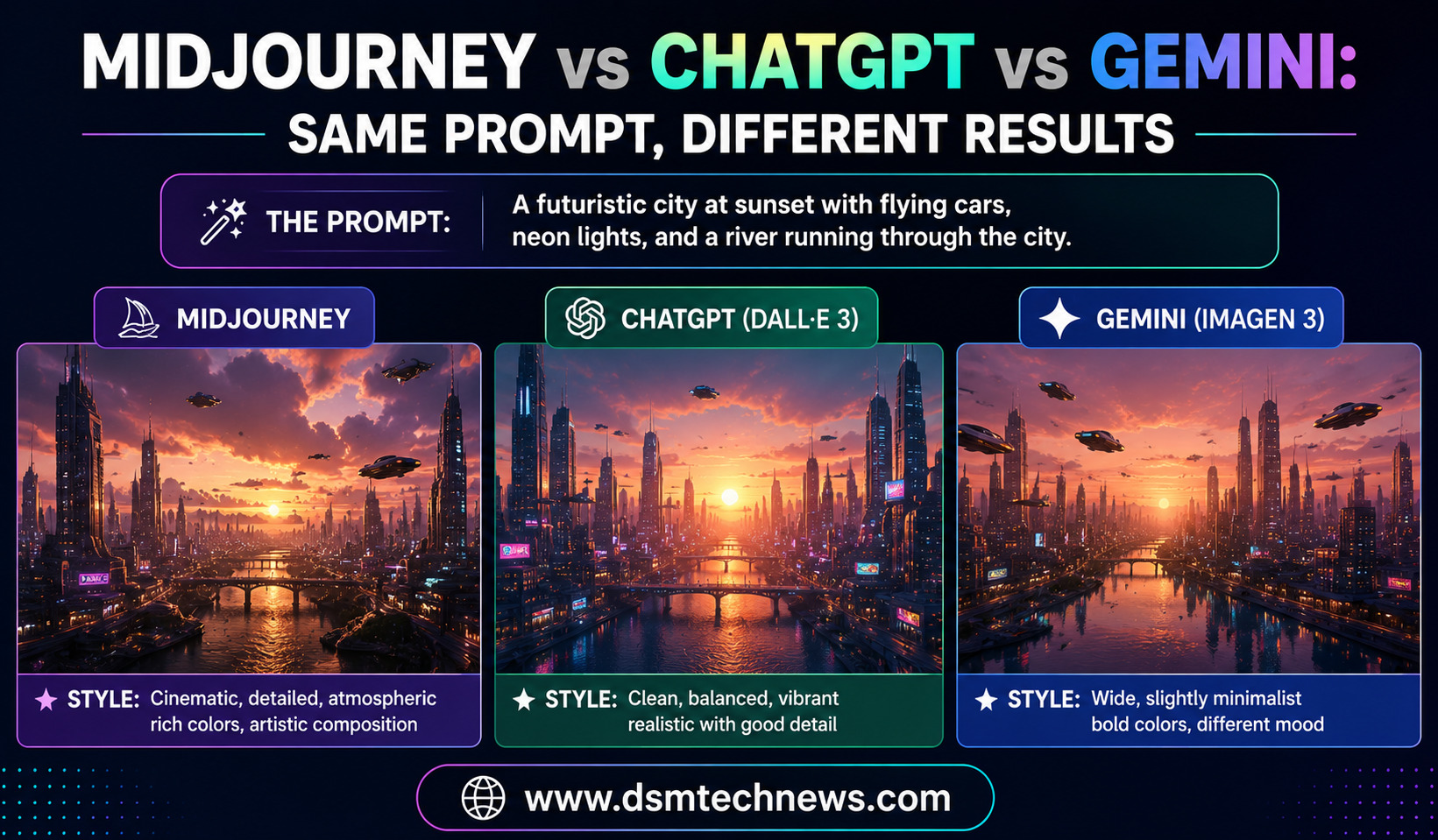
Midjourney vs ChatGPT vs Gemini: Same Prompt, Different Results

AI image generators have become powerful enough to create everything from realistic photographs and product images to illustrations, advertisements, blog graphics, and cinematic scenes. But while many AI tools can work from the same text prompt, they do not necessarily produce the same result.
This becomes especially interesting when comparing three popular AI platforms: Midjourney, ChatGPT, and Gemini.
Give all three the same prompt and you may get three completely different interpretations. One may prioritize artistic quality, another may follow the wording more literally, while another may produce a more polished and commercially useful composition.
As of 2026, all three platforms have continued to improve their image-generation capabilities. Midjourney’s V8.2 became its default version in July 2026, while ChatGPT Images 2.0 and Gemini’s newer image-generation models have also placed significant emphasis on instruction following, editing, and image quality.
So which one is actually better?
The answer depends on what you want to create.
Why the Same Prompt Produces Different Images
An AI image prompt is not a strict command that every image generator interprets identically.
Each platform has its own model architecture, training approach, visual preferences, prompting system, and image-generation technology. This means the same sentence can be interpreted differently by each model.
Consider a simple prompt:
“Create a cinematic photograph of a young Indian entrepreneur working on a laptop in a modern office during sunset.”
Midjourney might turn this into a highly stylized cinematic composition with dramatic lighting and carefully designed surroundings. ChatGPT may focus strongly on following the description and producing a balanced, realistic commercial scene. Gemini may interpret the business environment and storytelling elements differently.
None of these results is necessarily wrong. They are simply different interpretations of the same creative direction.
Midjourney: Best Known for Visual Style
Midjourney has built its reputation around visually striking AI-generated artwork.
Its current V8.2 model is designed around aesthetics, image quality, creativity, and personalization. Midjourney’s documentation describes V8.2 as more creative, sophisticated, and visually bold than previous versions.
When you give Midjourney a detailed cinematic prompt, it often produces images that immediately look like finished artwork. Lighting, composition, atmosphere, color relationships, and visual drama can be major strengths.
This makes Midjourney particularly appealing to people creating concept art, fantasy scenes, fashion visuals, cinematic artwork, character designs, and highly stylized images.
Midjourney also has strong reference-image capabilities. Its current V7 workflow includes Omni Reference, which allows creators to use a reference image for characters, objects, vehicles, and other subjects.
The platform also supports image prompts and style references, allowing creators to influence composition, colors, and visual appearance using existing images.
The main limitation is that Midjourney’s artistic interpretation can sometimes be stronger than the literal interpretation of your prompt. If you want the model to follow every instruction exactly, you may need to refine the prompt several times.
ChatGPT: Strong at Following Natural-Language Instructions
OpenAI’s ChatGPT Images takes a different approach.
One of its biggest advantages is the conversational workflow. You can describe what you want, generate an image, look at the result, and then tell ChatGPT exactly what you want changed.
OpenAI’s current image-generation guidance emphasizes clear, descriptive prompts and iterative refinement. The platform can generate images from natural-language descriptions and allows users to request variations, change composition, and explore different visual directions.
ChatGPT is particularly useful when your prompt contains many specific requirements.
For example, you could request a modern office scene, specify the character’s clothing, ask for a particular camera angle, reserve space for a headline, and request a specific aspect ratio.
If the first result is close but not perfect, you can continue the conversation rather than starting over with an entirely new prompt.
ChatGPT Images can also edit existing images. OpenAI says users can upload an image and describe the changes they want, making the tool useful for both generation and image editing.
This makes ChatGPT particularly practical for bloggers, marketers, business owners, and content creators who need to create and refine images through conversation.
Gemini: Strong for Context and Reference-Based Creation
Google’s Gemini image-generation capabilities are another major option for creators.
Gemini is particularly interesting when image creation is connected to broader instructions, references, or visual storytelling.
Google’s documentation describes workflows for using reference images to maintain character consistency and generate different views of the same character. Gemini’s image-generation tools can also work with multiple reference images in supported models.
This can be useful when you’re creating a fictional character for a story, a recurring person for a marketing campaign, or a visual identity that needs to remain recognizable across several images.
Gemini can also be useful when you want to explain an idea conversationally rather than construct a highly technical image prompt.
The Same Prompt: What Actually Changes?
Suppose you use this prompt across all three platforms:
“Create a realistic photograph of a young Indian entrepreneur sitting in a modern office, working on a laptop near a large window overlooking Mumbai, golden-hour sunlight, professional clothing, cinematic photography, realistic skin texture, shallow depth of field, 16:9 composition.”
Midjourney may emphasize the cinematic aspect of the request. You could get dramatic sunlight, carefully arranged office furniture, and an aesthetically polished composition.
ChatGPT may focus heavily on the individual instructions. The person’s clothing, office, laptop, window, city view, lighting, and composition may be represented in a more literal way.
Gemini may interpret the scene through a broader contextual lens and potentially emphasize the relationship between the entrepreneur, workspace, and city environment.
The important point is that the prompt is identical, but the models have different visual personalities.
Midjourney vs ChatGPT for Realistic Images
When creating realistic images, the difference can become subtle.
Midjourney often produces a polished photographic appearance with strong artistic direction. Even a relatively simple prompt can result in an image that feels intentionally composed.
ChatGPT focuses strongly on instruction following and editing. Its current image-generation system is designed to preserve important details during edits and follow detailed requests more precisely. OpenAI specifically highlights improved instruction following and preservation of important details such as facial likeness.
For a blogger who wants a realistic hero image matching a detailed article concept, ChatGPT can be especially convenient.
For someone who wants a visually dramatic editorial photograph with a distinctive aesthetic, Midjourney may be more attractive.
Midjourney vs Gemini for Creative Artwork
Midjourney has traditionally been associated with highly artistic image generation, and its current V8.2 release continues to emphasize aesthetics and creativity.
Gemini can be particularly useful when the creative process involves reference images, characters, and iterative storytelling.
For example, imagine you are creating a children’s story. You may want one character to appear in a forest, classroom, bedroom, and city while maintaining the same basic appearance.
Reference-based workflows can be more important than simply generating the most visually impressive individual image.
ChatGPT vs Gemini for Beginners
For beginners, conversational image generation can be easier than learning specialized prompting syntax.
With ChatGPT, you can describe an idea naturally and then refine it through conversation. You do not necessarily need to understand technical parameters to get started.
Gemini offers a similarly conversational approach, making it accessible to people who are already using Google’s AI ecosystem.
Midjourney can also be approachable through its web interface, but creators who want deeper control may eventually explore its reference systems, parameters, personalization features, and other tools.
Midjourney’s current documentation provides dedicated systems for image prompts, style references, and Omni References, giving experienced users more ways to control the output.
Which Tool Is Better for Blog Images?
For bloggers, the answer depends on the type of article.
If you need a clean technology image, business illustration, product concept, or realistic hero image with specific requirements, ChatGPT can be a practical choice because you can refine the image conversationally.
If you want an artistic or cinematic visual that immediately attracts attention, Midjourney can be a strong option.
Gemini can be particularly useful when the image needs to connect with a larger creative workflow involving references, characters, or multiple visual concepts.
For a website publishing many different types of articles, there is no reason to use only one tool. Different generators can be useful for different visual styles.
Which Tool Is Better for Product Images?
Product photography is another area where the differences become important.
If you provide a product reference and ask the AI to place it in a specific environment, the model needs to preserve important product characteristics while changing the surroundings.
ChatGPT’s image-editing capabilities make this kind of conversational refinement convenient. You can request changes to the background, lighting, composition, or surrounding environment while specifying that the product itself should remain unchanged.
Midjourney’s image and Omni Reference systems can also guide the appearance of objects from reference images.
However, businesses should carefully inspect AI-generated product images. Logos, packaging text, colors, proportions, and physical features should accurately represent the real product.
Which Tool Is Better for Characters?
Character generation is one of the most interesting areas of comparison.
Midjourney’s Omni Reference is specifically designed to bring a person, object, vehicle, or creature from a reference image into new creations.
Gemini also supports reference-based character workflows and can use multiple reference images in supported models.
ChatGPT can use uploaded images as part of an iterative editing and generation process, which can be useful when you want to maintain important visual characteristics while changing the scene.
For long-form storytelling, the best choice may come down to which workflow gives you the most consistent results for your particular character.
The Importance of Prompt Writing
The quality of the prompt still matters regardless of which generator you use.
A vague prompt gives the AI too much freedom. A strong prompt explains the subject, environment, lighting, composition, style, mood, and important constraints.
Instead of writing:
“Businesswoman in office.”
You could write:
“Photorealistic editorial photograph of a confident Indian businesswoman in her early 30s working on a laptop inside a bright contemporary office, floor-to-ceiling windows, modern city skyline outside, natural golden-hour lighting, realistic skin texture, sophisticated professional clothing, shallow depth of field, clean composition, wide horizontal framing.”
This gives every model much more information to interpret.
Don’t Judge the Tools From One Generation
One of the biggest mistakes when comparing AI image generators is judging them from a single image.
AI generation is probabilistic, which means two generations from the same model can look different.
A fair comparison should use the same prompt, similar settings where possible, several generations, and a clearly defined evaluation goal.
For example, you might compare how accurately each model follows the subject description, how realistic the people look, how well it handles text, how consistent the composition is, and how much editing is required afterward.
The “best” generator can change depending on the task.
Final Verdict: Midjourney vs ChatGPT vs Gemini
There is no universal winner in the Midjourney vs ChatGPT vs Gemini comparison.
Midjourney stands out when visual aesthetics, artistic direction, cinematic quality, and creative exploration are the priority. Its current V8.2 model and reference systems make it a powerful choice for creators who want strong visual control and distinctive results.
ChatGPT is particularly compelling for users who want natural-language prompting, detailed instruction following, image editing, and iterative refinement. Its current image tools are designed to make it easier to create and modify images through conversation.
Gemini is a strong option for creators who want conversational image generation combined with reference-based workflows and character consistency.
The best approach is not necessarily to choose one tool permanently. Try the same prompt in all three, compare the results for your specific use case, and then choose the generator that requires the least editing to reach the result you want.
AI image generation is moving quickly, and the differences between these platforms will continue to change. What matters most is not which tool has the biggest reputation, but which one consistently turns your ideas into the images you actually want.
AI image generators have become powerful enough to create everything from realistic photographs and product images to illustrations, advertisements, blog graphics, and cinematic scenes. But…