
Proxima: AI Assistance for Engineering Design Changes

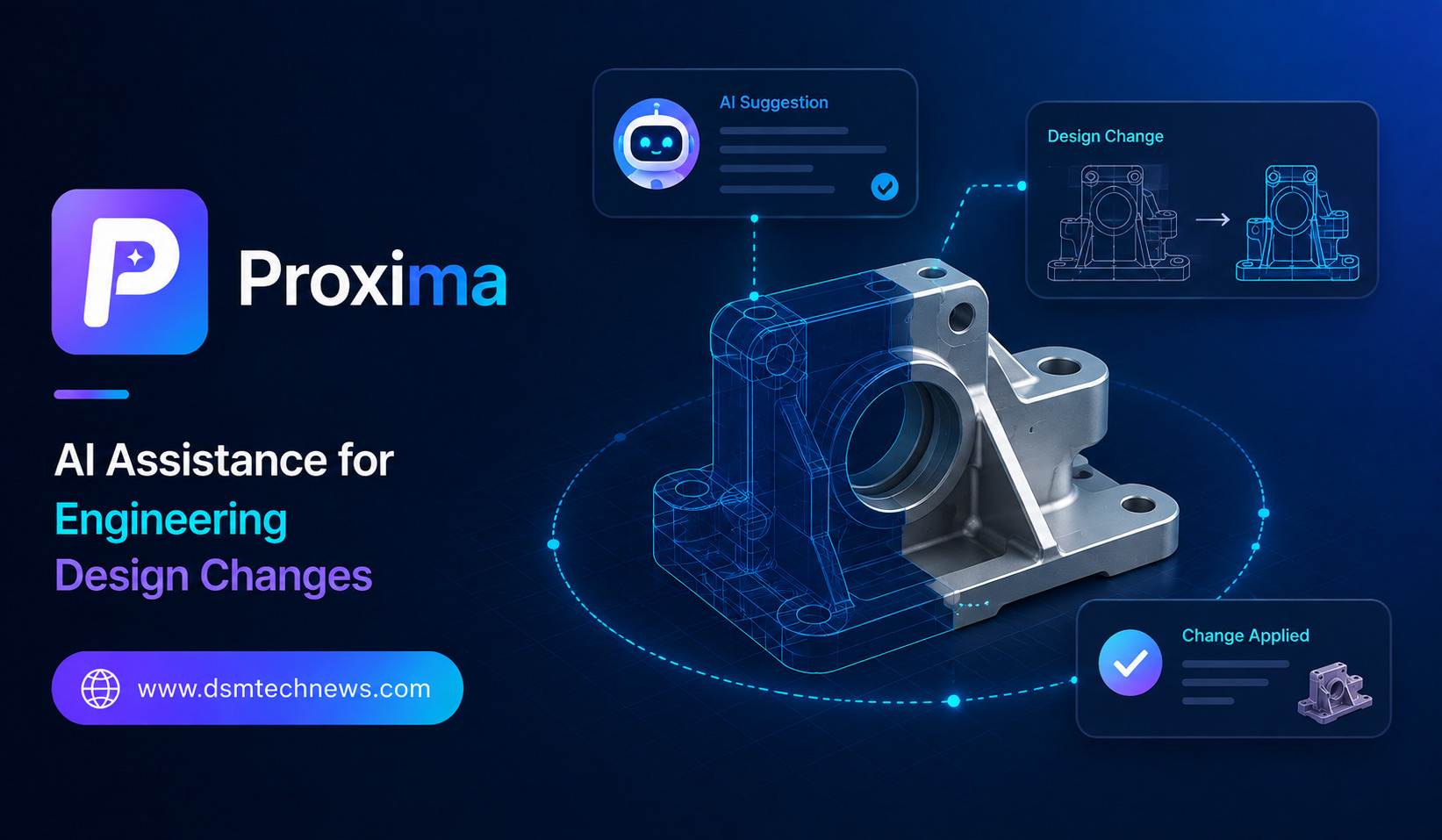
Engineering design is rarely a one-time process. Products, machines, components, buildings, and systems often go through multiple revisions before they are ready for manufacturing or deployment. A small change to one component can affect dimensions, materials, performance, costs, safety requirements, or other parts of the design.
As engineering teams work under increasing pressure to develop products faster, artificial intelligence is beginning to play a larger role in design workflows. Proxima represents this emerging category of AI assistance focused on helping engineers manage and understand design changes.
Rather than replacing engineers, AI tools for engineering can assist with repetitive analysis, documentation, design iterations, and decision-making. The objective is to reduce unnecessary manual work while allowing engineers to spend more time solving complex problems.
What Is Proxima?
Proxima can be viewed as an AI-assisted engineering design solution designed to support design changes and engineering workflows.
Engineering teams frequently work with complex designs containing many interconnected components. When one element changes, engineers may need to examine what else could be affected.
For example, changing the dimensions of a mechanical component could influence how it connects with another part. Modifying a material could affect weight, strength, cost, or manufacturing requirements.
AI assistance can help engineers navigate these changes by organizing relevant information, identifying relationships, and supporting the review process.
The exact capabilities available depend on the implementation, but the broader concept is to make engineering design changes easier to manage.
Why Engineering Design Changes Are Complicated
Design changes may look simple on paper but can create unexpected consequences.
Consider a product containing hundreds or thousands of components. If an engineer changes one component, determining every related dependency manually can take significant time.
Engineers may need to review CAD files, technical documentation, specifications, previous design versions, manufacturing information, and test results.
Documentation can also become difficult to maintain. A change made in one place may require updates across several documents and systems.
These challenges become more significant when products undergo frequent iterations.
An AI assistant can potentially help teams identify relevant information faster and reduce some of the administrative burden associated with design revisions.
How AI Can Assist Engineering Design
AI can support engineering design in several ways.
One area is information retrieval. Engineering organizations often have large amounts of technical information stored across different documents and systems. Finding the right specification or previous design decision can take time.
An AI-powered system can help engineers locate relevant information using natural-language queries.
Another area is change analysis. When a component or parameter is modified, AI can potentially help identify related elements that engineers should review.
AI can also assist with documentation by generating summaries of changes, preparing notes, and helping maintain consistent records.
These capabilities do not eliminate the need for engineering judgment. Instead, they can help engineers spend less time searching and documenting and more time evaluating technical decisions.
Managing Design Iterations
Product development often involves continuous iteration.
An initial design may be tested and then modified based on performance results. A prototype may reveal a manufacturing issue. A supplier may recommend a different material. A customer requirement may change.
Each of these situations can lead to a new design iteration.
Tracking those iterations can become challenging, particularly when multiple engineers are working on the same project.
AI assistance can help organize information about previous versions and make it easier to understand why certain changes were made.
This historical context can be valuable when engineers revisit an older design or need to determine whether a previous solution has already been tested.
Proxima and Engineering Productivity
One of the main potential advantages of AI-assisted engineering tools is productivity.
Engineers often spend a significant amount of time on activities surrounding design rather than directly designing. Searching through documents, comparing versions, preparing reports, updating records, and communicating changes can all consume valuable working hours.
Automating or accelerating some of these activities can give engineers more time for technical work.
For example, instead of manually preparing a summary of several design modifications, an AI assistant could help create an initial summary that the engineer reviews and corrects.
The time savings may appear small for one task, but across hundreds of design changes, the cumulative impact can be significant.
AI Assistance for CAD and Product Development
Computer-aided design, or CAD, is central to many engineering disciplines.
Modern engineering workflows may involve detailed three-dimensional models, assemblies, drawings, simulations, and technical specifications.
AI is increasingly being explored as a layer that works alongside these existing tools.
Rather than forcing engineers to abandon established CAD software, AI assistants can potentially provide additional intelligence around the design environment.
For example, an engineer could ask questions about a design, investigate relationships between components, or obtain a summary of recent changes.
This type of interaction could make complex engineering information easier to navigate.
Supporting Collaboration Between Engineering Teams
Engineering projects rarely involve one person.
Mechanical engineers, electrical engineers, software engineers, manufacturing specialists, quality teams, and project managers may all contribute to a product.
A design change made by one team can affect another team.
Clear communication is therefore essential.
AI can help by summarizing technical changes in a way that makes them easier for different teams to understand. It can also help organize information about dependencies and outstanding issues.
This can reduce the possibility of important changes being overlooked during collaboration.
Benefits of AI-Assisted Design Changes
The potential benefits extend beyond productivity.
Faster Information Access
Engineers can spend less time searching through large collections of technical documents and more time evaluating the information.
Better Change Visibility
AI can help highlight components, documents, or processes that may need review after a design modification.
Reduced Documentation Work
Routine summaries and records can be generated more efficiently, although engineers should verify the final content.
Faster Iteration
When engineers can evaluate and document changes more quickly, product development cycles may become more efficient.
Improved Knowledge Management
Engineering organizations accumulate valuable knowledge over many years. AI tools can make that information easier to access and reuse.
Human Engineers Remain Essential
AI assistance does not mean that engineering decisions should be fully automated.
Engineering involves safety, physics, materials science, regulations, manufacturing constraints, economics, and real-world testing. An AI system can provide useful recommendations or identify potentially relevant information, but it may not understand every physical or operational consequence of a design change.
Human engineers must therefore remain responsible for validating important decisions.
AI-generated suggestions should be treated as assistance rather than unquestionable answers.
For safety-critical industries such as aerospace, automotive, medical devices, energy, and industrial equipment, rigorous validation is particularly important.
Data Security Is an Important Consideration
Engineering designs can contain highly valuable intellectual property.
Product dimensions, manufacturing specifications, CAD models, test results, supplier information, and future product plans may be commercially sensitive.
Before introducing an AI system into an engineering environment, organizations should understand how their data is stored, processed, accessed, and protected.
Companies should also establish appropriate permissions so that employees and AI systems only access information they are authorized to use.
Security is especially important when AI tools connect to internal engineering databases or product-development systems.
Who Can Benefit From Proxima?
AI-assisted design-change solutions may be useful for engineering companies, manufacturers, product-development teams, automotive organizations, industrial businesses, electronics companies, and other organizations that manage complex technical designs.
The greatest value may come from environments where products undergo frequent revisions and teams work with large amounts of interconnected engineering information.
Smaller teams may also benefit because AI can help them manage growing workloads without requiring the same level of administrative effort.
The Future of AI in Engineering Design
AI is likely to become increasingly integrated into engineering software.
Future systems may move beyond answering questions and generating documentation. They could potentially understand relationships between components, identify possible design conflicts, compare historical designs, and assist engineers during different stages of product development.
The engineering workstation of the future may therefore include an AI assistant that understands not only the current design but also its history, requirements, documentation, and dependencies.
However, successful adoption will depend on accuracy, security, integration, and trust.
Engineers need systems that provide useful information without creating additional verification work. AI tools must therefore become reliable enough to support professional workflows while clearly communicating uncertainty when appropriate.
Final Thoughts
Proxima represents the broader movement toward AI-assisted engineering design changes. As products become more complex and development cycles become shorter, engineering teams need better ways to manage revisions, technical information, and collaboration.
AI can help reduce repetitive work by assisting with information retrieval, change analysis, documentation, and design history. This can allow engineers to concentrate more heavily on technical reasoning and innovation.
The technology should not be viewed as a replacement for engineering expertise. Instead, its greatest potential may come from acting as an intelligent assistant that helps engineers find information faster and manage complicated design workflows.
As AI continues to evolve, tools focused on engineering design could become an important part of modern product development, helping teams move from one design iteration to the next with greater speed, organization, and confidence.
Engineering design is rarely a one-time process. Products, machines, components, buildings, and systems often go through multiple revisions before they are ready for manufacturing or…