
Buda: Running Multi-Agent AI Teams in the Cloud

Artificial intelligence is moving beyond simple chatbots and single-purpose assistants. Today, AI agents can research information, write code, analyze data, automate workflows, communicate with users, and complete multi-step tasks with limited human intervention. The next major development is the ability to coordinate multiple AI agents as a team.
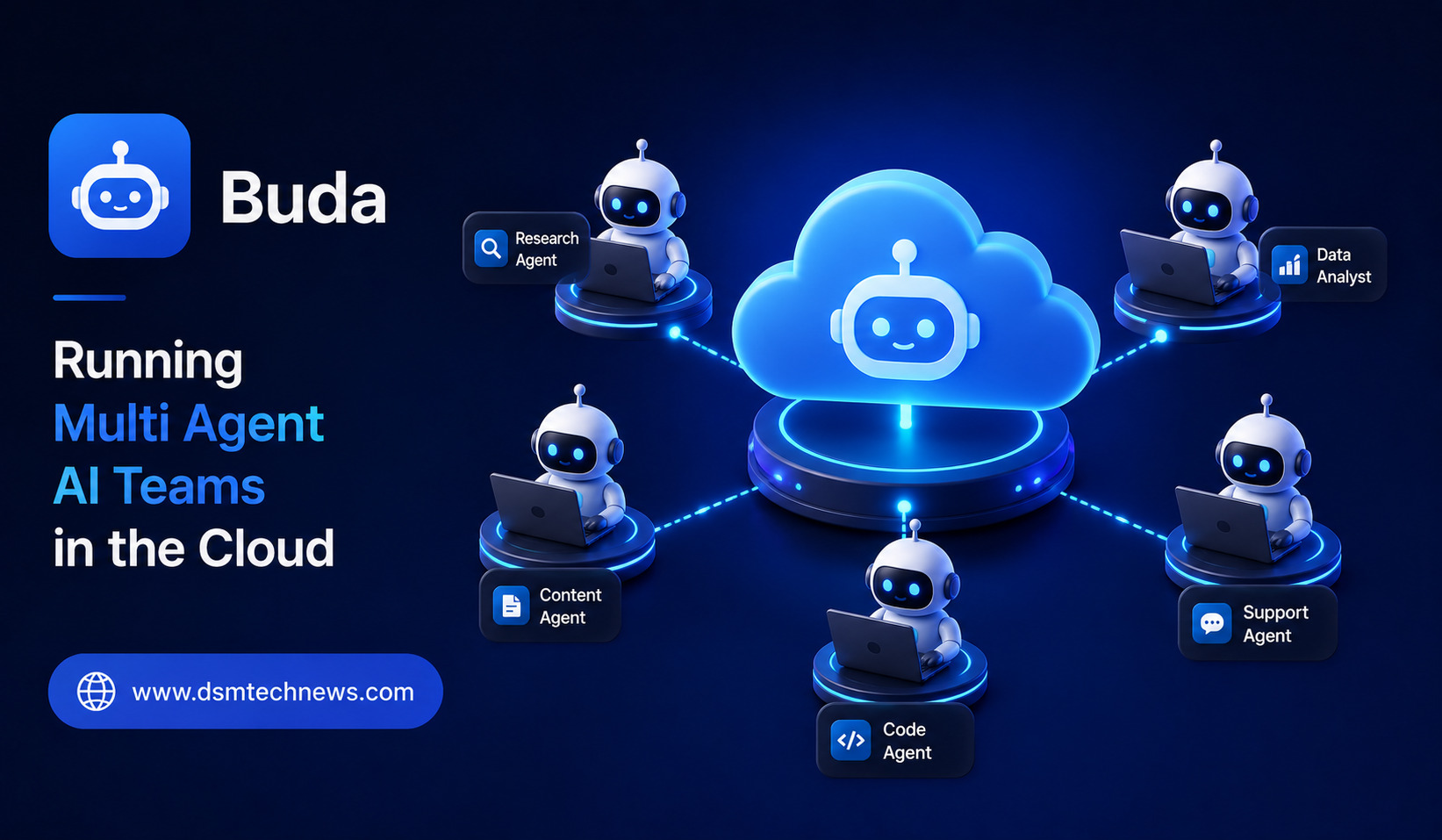
Buda focuses on this emerging approach by enabling developers and businesses to run multi-agent AI teams in the cloud. Instead of relying on one AI agent to complete an entire project, users can organize several agents with different responsibilities and allow them to work together.
This approach could make AI automation more scalable, especially for businesses that want to move from individual AI experiments to larger, automated workflows.
What Is Buda?
Buda is centered around the concept of running multiple AI agents within a cloud-based environment. The idea is to create a digital team where different agents can be assigned different roles and collaborate on broader objectives.
For example, one agent could handle research, another could analyze the information, while a third prepares a report based on the results.
Rather than treating every AI agent as an isolated tool, a multi-agent platform connects them into a coordinated workflow.
Cloud infrastructure is particularly important because it allows these agents to operate without requiring every task to run directly on a user’s personal computer.
Why Multi-Agent AI Teams Matter
A single AI agent can be powerful, but complex projects often involve multiple types of work.
Consider a company researching a new market. The overall task might involve collecting competitor information, analyzing pricing, identifying customer trends, summarizing findings, and preparing a final report.
One AI agent could theoretically attempt all of these tasks. However, specialized agents can divide the workload.
A research agent could gather information, an analysis agent could identify patterns, and a writing agent could turn the findings into a structured report.
This creates a workflow that resembles a small virtual team.
The important advantage is specialization. Each agent can be given a focused objective rather than being responsible for everything.
How Cloud-Based AI Agents Work
Running AI agents in the cloud provides several practical benefits.
Instead of depending entirely on a local computer, cloud-based agents can run on remote infrastructure. This can make it easier to execute longer or more resource-intensive tasks.
Users can potentially start an AI workflow and allow agents to continue working while they focus on other activities.
Cloud infrastructure can also support scaling. If a project requires several agents, the system can potentially manage those workloads without requiring users to configure separate computers for each agent.
This is particularly relevant for organizations that want AI automation to operate continuously.
Creating Specialized AI Roles
One of the most useful aspects of a multi-agent system is role assignment.
Different agents can be designed for different jobs.
For example, an AI team could include:
- A research agent for collecting information
- An analyst agent for evaluating data
- A coding agent for software development
- A testing agent for checking results
- A writing agent for producing documentation
- A coordinator agent for managing the workflow
These roles do not necessarily need to operate independently. Agents can pass information between stages and contribute to a shared objective.
This structure can make complicated AI workflows easier to design and understand.
Parallel AI Workflows
Multi-agent systems can potentially improve efficiency by allowing independent tasks to happen simultaneously.
Suppose a business wants to create a detailed competitor report. Instead of asking one AI system to research every competitor sequentially, several research agents could work on different companies at the same time.
Their findings could then be passed to another agent responsible for comparison and analysis.
This type of parallel processing can reduce the time required for large research projects.
However, parallel execution works best when tasks are genuinely independent. If several agents modify the same information or depend heavily on one another, coordination becomes more complicated.
Buda and AI Automation
The broader value of Buda is its potential role in AI automation.
Traditional automation generally follows fixed rules. A workflow might say that when one event occurs, perform a specific action.
AI agents introduce greater flexibility. They can interpret instructions, make decisions within defined boundaries, and adapt their actions based on information they encounter.
A multi-agent system takes this concept further.
Instead of creating one large automated process, businesses can divide the workflow among several specialized AI workers.
For example, an online business could use one agent to monitor customer questions, another to categorize them, and another to prepare responses for human approval.
This can turn AI from an occasional assistant into part of an ongoing business process.
Benefits for Developers
Developers can use multi-agent cloud environments for experimentation and application development.
Instead of manually creating separate infrastructure for every AI process, a centralized environment can make it easier to test different agent configurations.
Developers can experiment with questions such as:
Which agent should handle a particular task?
When should one agent transfer work to another?
What information should agents share?
Which tasks should happen simultaneously?
When should a human approve the result?
Answering these questions is becoming increasingly important as AI applications become more autonomous.
Benefits for Businesses
Businesses can potentially use multi-agent AI teams for a wide variety of activities.
Marketing teams could use agents for research, content planning, competitive analysis, and reporting.
Sales teams could use AI agents to research prospects, organize information, and prepare personalized outreach.
Operations teams could automate repetitive information-processing tasks.
Software companies could create AI development teams where different agents handle coding, testing, documentation, and troubleshooting.
The key benefit is not simply automation. It is the ability to coordinate multiple AI capabilities around one business objective.
Challenges of Multi-Agent AI
Despite the potential advantages, running multiple AI agents introduces new challenges.
The first is coordination. If agents do not share information correctly, the final result can become inconsistent.
Another issue is cost. Running several AI agents simultaneously may require more computing resources and more model usage than relying on a single agent.
There is also the problem of reliability. AI agents can make mistakes, misunderstand instructions, or take an inefficient approach to a task.
For this reason, multi-agent systems should include appropriate monitoring and safeguards.
Businesses also need to decide when human intervention is required. Important financial, legal, security, or customer-facing decisions should not necessarily be left entirely to autonomous AI systems.
Security and Access Control
Cloud-based AI agents may interact with databases, APIs, documents, software systems, and other business resources.
That makes security particularly important.
An AI agent should not automatically have unrestricted access to an organization’s infrastructure. Permissions should be limited according to the agent’s role.
For example, a research agent may only need access to approved information sources, while a coding agent may need access to a development environment.
Separating permissions can reduce the potential impact of mistakes or unauthorized actions.
The Future of AI Agent Teams
The development of multi-agent AI systems suggests that the future of artificial intelligence may involve more than increasingly powerful individual models.
Instead, applications could combine multiple specialized agents that cooperate to accomplish larger objectives.
A future AI business system might include agents responsible for sales, customer support, research, finance, development, and operations, all coordinated through a central system.
Humans could act as managers of these digital teams, setting objectives, reviewing important outcomes, and making strategic decisions.
Cloud infrastructure could make this model easier to operate at scale.
Final Thoughts
Buda represents an interesting direction in the evolution of AI automation by focusing on running multi-agent AI teams in the cloud.
The concept combines specialized AI agents with cloud infrastructure, allowing different digital workers to collaborate on larger tasks. This can potentially improve scalability, parallel processing, workflow automation, and experimentation.
However, simply adding more AI agents does not guarantee better results. Successful multi-agent systems need clear roles, reliable communication, strong monitoring, sensible permissions, and human oversight.
As AI agents become more capable, the next challenge will increasingly be about coordination rather than individual intelligence. Platforms like Buda highlight a future where businesses may not just use AI assistants—they may manage entire teams of AI agents working together in the cloud.
Artificial intelligence is moving beyond simple chatbots and single-purpose assistants. Today, AI agents can research information, write code, analyze data, automate workflows, communicate with users,…