
Ask AI Free: Accessing Multiple AI Models in One Chat

Artificial intelligence has changed the way people search for information, write content, solve problems, generate ideas, and complete everyday tasks. However, one challenge has become increasingly common: which AI model should you use?
Different AI models can produce different results for the same prompt. One may be better at writing, another at coding, another at reasoning, while a different model may provide stronger results for research or creative tasks. Switching between multiple AI platforms can therefore become inconvenient.
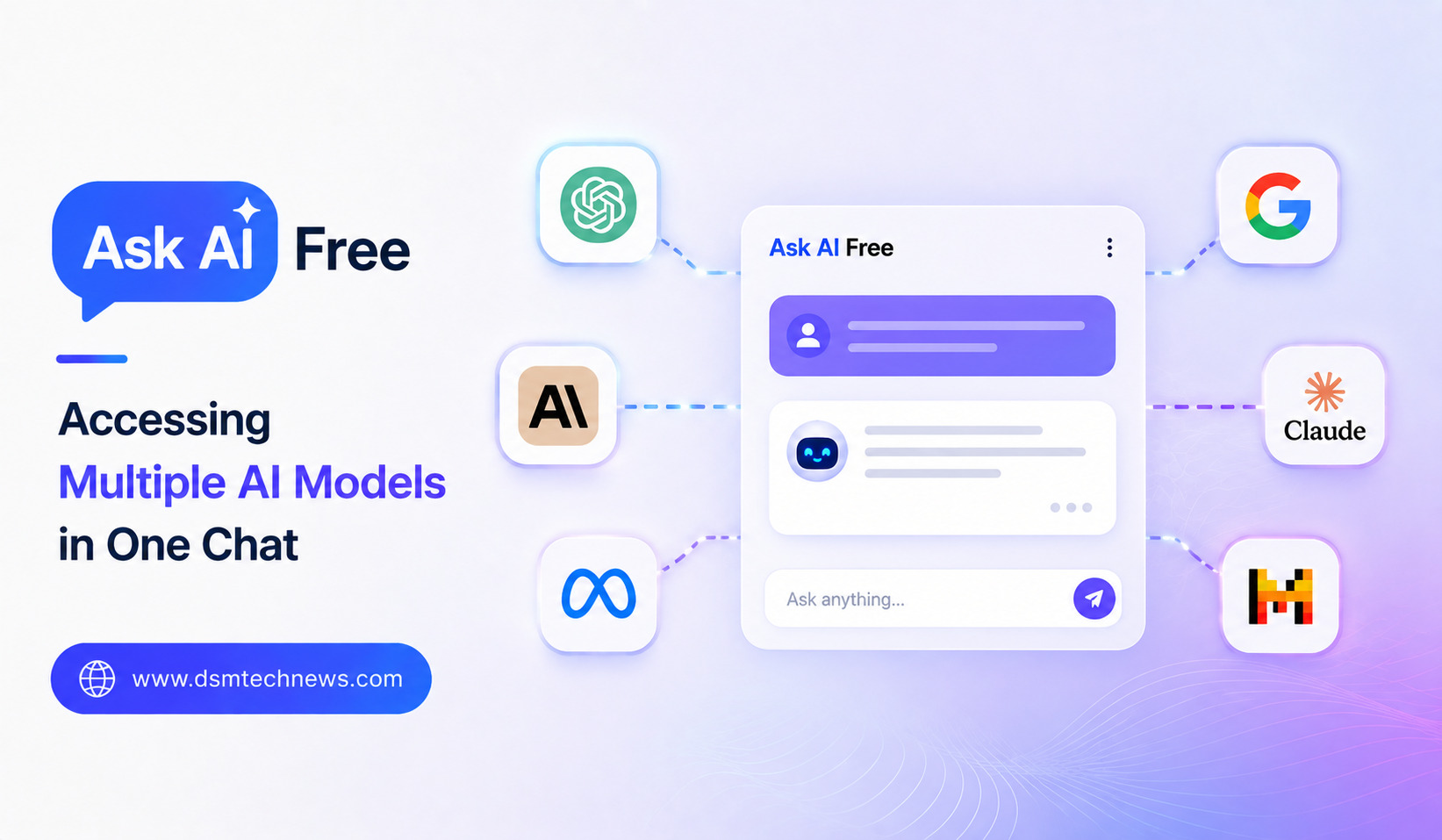
This is where Ask AI Free fits into the growing trend of multi-model AI platforms. Instead of requiring users to open several different AI applications, a multi-model chat platform can provide access to multiple AI models through one interface.
The concept makes AI experimentation easier and gives users more flexibility when deciding which model is best for a particular task.
What Is Ask AI Free?
Ask AI Free is an AI chat concept focused on providing users with access to AI capabilities through a single conversational interface.
Rather than relying on only one underlying language model, platforms in this category can bring together multiple AI models. Users can interact with different models without constantly moving between separate websites or applications.
This approach is becoming increasingly relevant as the AI ecosystem expands. There are now numerous models designed for different types of workloads, and users may want to compare their responses before choosing the most useful answer.
For someone who regularly uses AI for writing, research, coding, brainstorming, or business tasks, having multiple models available in one place can simplify the workflow.
Why Use Multiple AI Models?
No single AI model is necessarily perfect for every task.
A model that produces excellent marketing copy may not always be the best option for technical reasoning. Similarly, a model that performs well at programming may not produce the most creative response when writing a story or social media post.
Using multiple models gives users the opportunity to approach a problem from different perspectives.
For example, a user could ask several models to explain a complicated concept and compare their answers. If the responses agree on the important points, the user may have greater confidence in the information. If they disagree, the differences can signal that additional verification is needed.
This makes multi-model AI particularly useful for experimentation.
How a Multi-Model AI Chat Works
The basic experience is similar to using a regular AI chatbot.
A user enters a question or instruction into the chat interface. Depending on the platform’s available features, the user may then select a particular model or allow the system to determine which model should handle the request.
The platform sends the request to the selected AI model and displays the response within the same conversation environment.
Instead of opening separate browser tabs for different AI services, users can manage their interactions from one place.
Some multi-model platforms may also provide features for comparing responses, switching models during a conversation, or continuing a discussion with a different model.
The exact functionality depends on the platform, but the central idea remains the same: multiple AI models, one chat experience.
Benefits of Ask AI Free
One of the biggest advantages is convenience.
Users do not need to repeatedly switch between different AI websites simply to compare responses. A centralized interface can make the process faster and easier.
Another benefit is model comparison. When users can access multiple models, they can evaluate different responses to the same question.
This can be particularly useful for developers and AI enthusiasts who want to understand how different models behave.
Multi-model access can also encourage experimentation. Instead of automatically using the same model for every task, users can try different approaches and discover which model works best for specific requirements.
For students, writers, marketers, entrepreneurs, and developers, this flexibility can improve the overall AI workflow.
AI Models for Different Tasks
Different AI models can have different strengths.
For content writing, users may prioritize natural language, creativity, tone control, and structure.
For coding, accuracy, reasoning, context handling, and understanding of programming languages can be more important.
For research, users may care about the ability to analyze long pieces of information and provide clear summaries.
For business tasks, users may prioritize structured thinking, professional communication, and reliable output.
A multi-model platform allows users to experiment rather than assuming that one model will always deliver the best result.
This can be especially useful as new AI models are released. Instead of rebuilding their workflow around every new model, users can potentially access multiple options from the same interface.
Ask AI Free for Content Creators
Content creators can benefit significantly from having multiple AI models available.
A blogger might use one model to generate article ideas, another to create an outline, and another to improve the language.
Similarly, a social media manager could compare different models when developing captions, campaign ideas, headlines, or promotional concepts.
However, AI-generated content should still be reviewed and edited by humans. AI can produce inaccurate information, repetitive writing, or statements that lack appropriate context.
The best results generally come from using AI as a productivity tool rather than treating its output as automatically correct.
Ask AI Free for Developers
Developers are another major audience for multi-model AI tools.
Different models can behave differently when generating code, debugging errors, explaining programming concepts, or designing software architectures.
A developer can potentially submit the same coding problem to multiple models and compare the approaches.
This can help identify alternative solutions that might not appear when using a single AI system.
However, generated code should always be tested before being used in a real application. AI models can introduce bugs, security problems, inefficient approaches, or outdated recommendations.
Multi-Model AI for Research and Learning
Students and researchers can also use multi-model platforms to explore complex subjects.
Instead of asking one AI model to explain a topic once, users can request explanations from different models and compare the results.
This can help reveal different interpretations and make difficult concepts easier to understand.
At the same time, AI should not replace reliable sources. Important academic, scientific, financial, or legal information should be verified using authoritative references.
Multi-model AI is most useful when it supports critical thinking rather than replacing it.
Free AI Access and Its Limitations
The word “free” can be attractive to users, but free AI services may have limitations.
A platform may restrict the number of messages, available models, response speed, context length, or advanced features. Some services may offer additional capabilities through paid plans.
Users should therefore check the current terms of the specific service before relying on it for important or high-volume work.
Privacy is another important consideration. Users should understand how their conversations and uploaded information are handled before entering confidential business information, personal data, passwords, financial details, or proprietary documents into an AI platform.
Is Using Multiple AI Models Better Than Using One?
It depends on the user’s needs.
For simple everyday questions, using one familiar AI assistant may be sufficient. Constantly comparing models can actually make the process slower.
For more complicated tasks, however, multiple models can provide useful perspectives.
The biggest advantage is not necessarily that one model will always produce a better answer. Instead, it is the ability to choose, compare, and experiment.
This approach gives users greater control over how they use AI.
The Future of Multi-Model AI Platforms
The AI industry is moving toward an environment where users have access to an increasing number of specialized models.
As this happens, platforms that bring multiple models together could become increasingly useful.
Future AI interfaces may automatically determine which model is best suited to a particular request. A complex question could potentially be routed to a reasoning-focused model, while a creative writing request could be handled by a model optimized for language generation.
Users may not even need to understand the technical differences between models. The platform could manage model selection while presenting the results through a single conversation.
This could make advanced AI more accessible to people who do not want to learn the technical details of every available model.
Final Thoughts
Ask AI Free represents the broader idea of making multiple AI models available through one convenient chat experience.
Instead of being tied to a single model, users can explore different AI systems, compare responses, and select the approach that works best for their particular task.
For writers, developers, students, marketers, researchers, and business users, this flexibility can make AI experimentation more practical.
However, users should still consider limitations such as free-plan restrictions, privacy policies, response accuracy, and model capabilities. AI-generated answers should also be reviewed before being used for important decisions.
As the number of capable AI models continues to grow, multi-model platforms could become an increasingly important part of the AI landscape. The future of AI may not be about finding one model that does everything, but about giving users access to the right model for the right task through a simple and unified interface.
Artificial intelligence has changed the way people search for information, write content, solve problems, generate ideas, and complete everyday tasks. However, one challenge has become increasingly common: which AI model should you use? Different AI models can produce different results for the same prompt. One may be better at writing, another at coding, another at…