
Aldena: AI Agents for Recurring Client Work

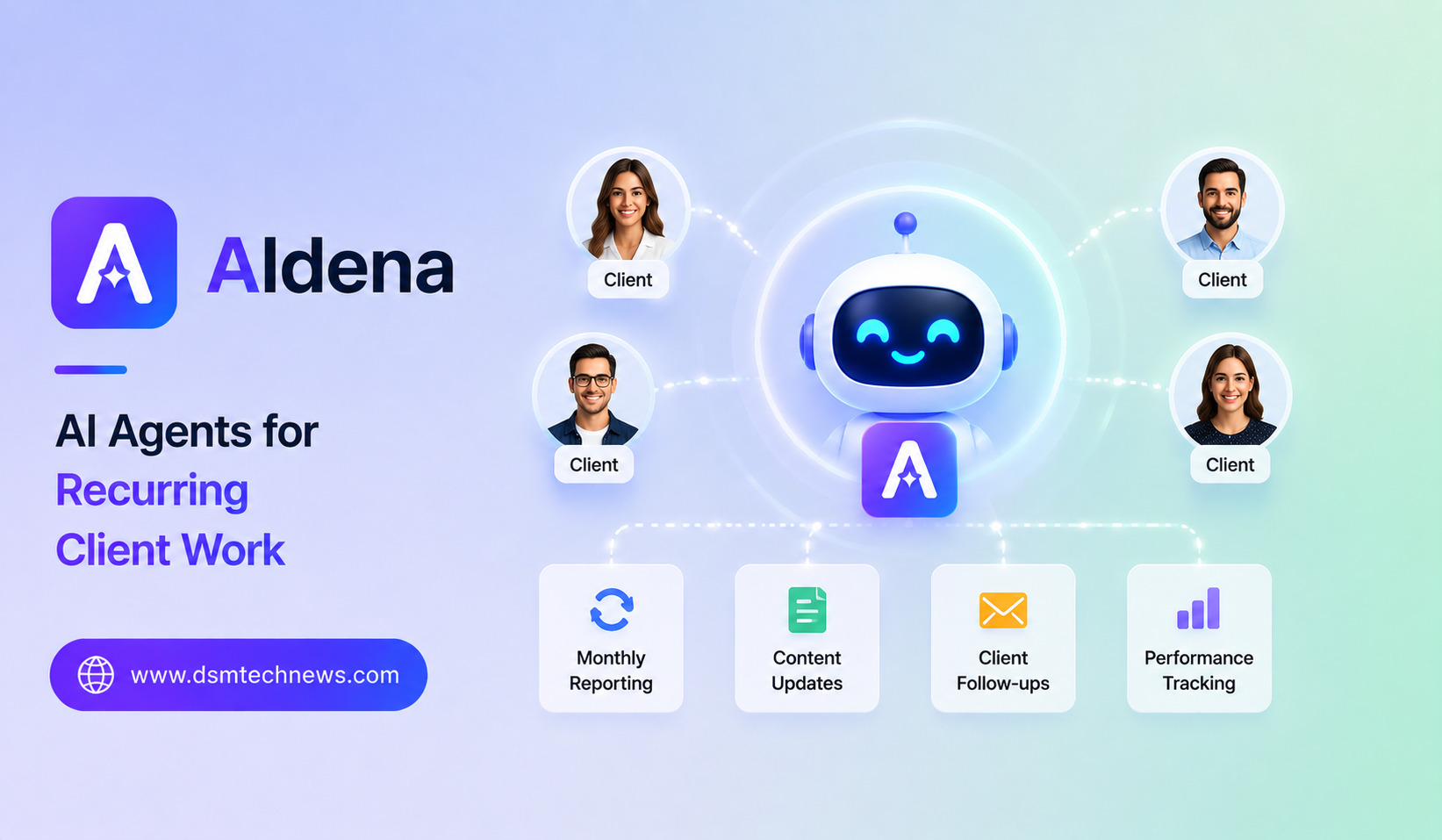
Businesses that work with multiple clients often spend a large part of their day handling repetitive tasks. Sending follow-up emails, preparing reports, organizing information, updating client records, checking project progress, and responding to routine requests may not seem difficult individually, but together they can consume hours every week.
Aldena is part of the growing wave of AI-powered tools designed to help businesses manage this type of recurring client work. Instead of using AI only as a chatbot or writing assistant, the idea behind AI agents is to give software a specific job and allow it to carry out multiple steps with less manual intervention.
For agencies, consultants, freelancers, service businesses, and teams managing ongoing customer relationships, AI agents can potentially reduce repetitive work while helping employees focus on higher-value activities.
What Is Aldena?
Aldena can be understood as an AI-agent approach focused on recurring client work. Rather than requiring a person to repeatedly perform the same workflow, AI agents can be configured around particular tasks and processes.
Traditional automation usually follows predefined rules. For example, a workflow might send an email whenever a specific form is submitted. AI agents can go a step further by working with information, interpreting requests, generating responses, and completing several connected tasks.
This makes the concept particularly interesting for businesses where client work changes slightly from one situation to another but still follows a recognizable process.
For example, a marketing agency may need to collect campaign information, review performance data, prepare a client update, and organize the next set of actions every month. An AI agent could assist with several parts of this recurring workflow rather than simply completing one isolated task.
Why Recurring Client Work Is a Challenge
Recurring work is essential to many service businesses. Retainer-based agencies, accounting firms, consulting companies, recruitment businesses, software providers, and freelancers may perform similar activities for clients every week or month.
The problem is that repetitive work can become a hidden productivity cost.
Employees may spend time copying information between systems, creating similar documents, writing routine emails, preparing meeting summaries, or checking whether a task has been completed. These activities require attention even when they do not require significant strategic thinking.
As the number of clients increases, these small tasks can become a major operational burden.
This is where AI agents can become useful. Instead of simply helping a worker complete a task faster, an agent can potentially take responsibility for a larger workflow while keeping humans involved where judgment is important.
How AI Agents Can Support Client Work
One of the biggest advantages of an AI-agent model is its ability to connect multiple steps.
Consider a company that provides monthly consulting services. At the beginning of each month, someone might need to gather information, review previous activity, create a report, identify outstanding items, and contact the client.
An AI agent could potentially help coordinate these activities.
It could organize available information, identify relevant details, draft a report, prepare a client communication, and highlight areas that require human attention. The employee can then review the work instead of starting everything from scratch.
The exact capabilities depend on the implementation and integrations available, but the broader goal is to make recurring workflows less dependent on manual effort.
Common Use Cases for Aldena-Style AI Agents
There are many types of recurring client work where AI agents can be useful.
Client Communication
Businesses regularly send follow-ups, reminders, updates, and status messages. AI agents can help prepare these communications based on the latest available information.
Instead of writing every routine message manually, a team member could review an AI-generated draft and make adjustments before sending it.
Reporting
Monthly and weekly reporting can involve collecting information from several sources and turning it into an understandable format.
An AI agent can assist with organizing information, summarizing developments, and preparing reports. Human review remains important, particularly when reports contain financial, legal, or business-critical information.
Task Follow-Ups
Client projects often contain unfinished tasks. Someone has to remember what is pending, determine who is responsible, and follow up at the right time.
AI-powered workflows can help monitor these recurring processes and bring attention to items that need action.
Research and Information Gathering
Some client services require regularly collecting information from different sources.
An AI agent can potentially assist with gathering and organizing relevant information, saving employees from repeatedly performing the same initial research steps.
Meeting Preparation
Recurring client meetings often require similar preparation. Teams may need to review previous discussions, collect current project information, and prepare an agenda.
AI agents can help organize these materials so employees spend less time preparing and more time focusing on the client conversation itself.
Aldena vs Traditional Automation
It is important to distinguish AI agents from conventional automation.
Traditional automation is generally based on clear instructions. If event A happens, perform action B. This approach works extremely well when processes are predictable.
AI agents are more flexible because they can work with natural language and unstructured information. They may be able to interpret context and decide which step should happen next within a defined workflow.
However, AI agents are not automatically better for every process.
A simple repetitive task may be more reliable and cheaper with conventional automation. AI becomes more valuable when the workflow involves documents, language, changing information, or decisions that require some contextual understanding.
For businesses, the best approach may therefore be a combination of traditional automation and AI agents.
Benefits of Using AI Agents for Client Work
The main benefit is time savings. When repetitive activities are handled or assisted by AI, employees can spend more time on strategy, creativity, sales, relationship building, and problem-solving.
Another benefit is consistency. A defined AI workflow can help ensure that recurring processes follow the same basic structure each time.
AI agents may also help businesses scale. A small team managing a growing number of clients can face increasing administrative pressure. Automating parts of recurring work can make growth easier without increasing manual workload at the same rate.
There is also a potential benefit in reducing forgotten tasks. Automated workflows can help surface follow-ups and recurring responsibilities that might otherwise be missed during busy periods.
Human Oversight Still Matters
AI agents should not be treated as completely independent employees without supervision.
AI systems can misunderstand information, produce inaccurate content, or make inappropriate assumptions. The consequences can be particularly serious when client communications involve contracts, finances, legal matters, confidential information, or sensitive business decisions.
A better approach is to establish clear boundaries.
Low-risk tasks can potentially be automated more extensively, while high-impact decisions should remain under human control. Businesses should also establish review processes before allowing an AI agent to send communications or make changes automatically.
The goal is not necessarily to remove people from workflows. It is to remove unnecessary manual work while allowing people to focus on the parts that require judgment.
Who Can Benefit From Aldena?
AI-agent solutions for recurring client work may be particularly useful for digital agencies, consultants, freelancers, accountants, recruiters, customer-success teams, marketing companies, and other service businesses.
The strongest use case is usually a workflow that happens repeatedly and follows a recognizable pattern.
If a business performs the same process every week or month, it is worth examining which steps are repetitive and which require genuine human expertise.
For example, an agency might discover that employees spend only 20% of their time on strategic client work and the rest on administrative activities. Even partially automating those administrative processes could have a meaningful impact on productivity.
Things to Consider Before Adopting AI Agents
Businesses should evaluate an AI-agent platform based on more than its ability to generate impressive responses.
Data security should be a priority, particularly when client information is involved. Companies should understand how information is stored, processed, and protected.
Integration is another important consideration. An AI agent becomes more useful when it can work with the tools a business already uses, rather than forcing employees to constantly move information between different platforms.
Reliability is equally important. Before automating an important workflow, businesses should test the system with real-world scenarios and establish fallback procedures.
Finally, companies should calculate the actual return on investment. Saving several hours every week may be valuable, but businesses should compare that benefit with subscription costs, implementation time, training, and ongoing monitoring.
The Future of AI Agents in Client Services
AI agents are likely to become increasingly important as businesses look for ways to operate more efficiently.
The next stage of business automation is not simply about generating text faster. It is about creating systems that can understand a goal, work through multiple steps, interact with business software, and return useful results.
For client-focused companies, this could change how recurring services are delivered. Instead of employees spending hours managing administrative processes, AI agents could handle more of the operational workload while humans concentrate on relationships and strategic decisions.
Aldena represents this broader shift toward using AI agents for recurring client work. The value of such technology will ultimately depend on how well it fits into real business processes and how effectively companies combine AI capabilities with human oversight.
Final Thoughts
Recurring client work is necessary, but not every part of it needs to be performed manually.
Aldena and similar AI-agent solutions highlight a growing opportunity for businesses to automate repetitive workflows while keeping people involved in important decisions. From communication and reporting to research, follow-ups, and meeting preparation, AI agents can potentially reduce administrative workload and improve operational efficiency.
For businesses considering AI adoption, the best starting point is simple: identify the recurring tasks that consume the most time, determine which steps are suitable for automation, and introduce AI gradually with appropriate human review.
When implemented thoughtfully, AI agents can become more than productivity tools. They can become part of a company’s everyday operating system, helping teams manage recurring client work more efficiently as the business grows.
Businesses that work with multiple clients often spend a large part of their day handling repetitive tasks. Sending follow-up emails, preparing reports, organizing information, updating…