
Eva AI: Supporting Sales and Customer Service With AI Agents

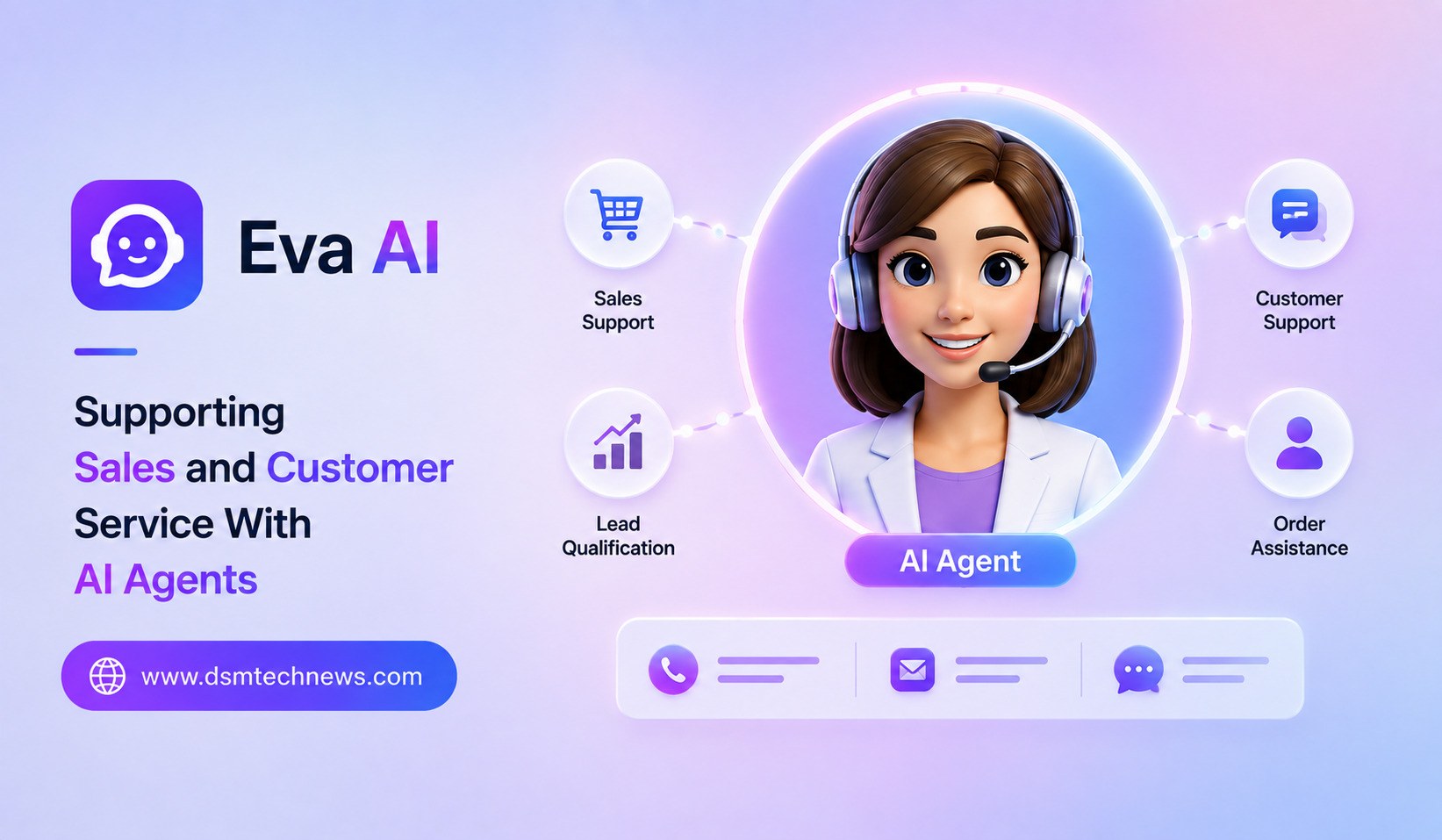
Artificial intelligence is changing how businesses communicate with customers, manage sales opportunities, and handle everyday support requests. While traditional customer service software mainly helps employees organize conversations, modern AI agents can take a more active role by understanding requests, generating responses, qualifying leads, and assisting teams with repetitive tasks.
Eva AI represents this growing approach to business automation, where AI agents can support sales and customer service operations. Instead of relying entirely on employees to respond to every inquiry or manually process every lead, businesses can use AI to manage parts of the customer journey.
For startups, online businesses, service providers, and growing companies, this can create opportunities to respond faster while allowing human employees to concentrate on more complex interactions.
What Is Eva AI?
Eva AI is an AI-focused solution aimed at supporting business communication and customer-facing workflows. The broader idea behind platforms like Eva AI is to use intelligent agents to assist with tasks that traditionally require human attention.
Sales and customer service involve many repetitive activities. Teams may answer similar questions, collect customer information, qualify prospects, follow up on inquiries, and route conversations to the appropriate employee.
AI agents can assist with these processes by interpreting customer messages and taking appropriate actions based on predefined business objectives.
Rather than treating AI simply as a chatbot that provides generic answers, the AI agent model focuses on completing useful tasks within a business workflow.
How AI Agents Are Changing Sales
Sales teams spend a significant amount of time looking for potential customers and managing early-stage conversations. Not every prospect is ready to speak with a salesperson immediately, and many inquiries require basic information before a sales representative becomes involved.
An AI agent can help manage this initial stage.
For example, when a potential customer contacts a business, an AI agent can respond to basic questions, understand what the customer is looking for, and collect relevant information. The conversation can then be evaluated to determine whether the prospect may be suitable for further sales engagement.
This allows sales professionals to spend more time with qualified prospects instead of manually handling every initial inquiry.
Lead Qualification With AI
Lead qualification is one of the areas where AI agents can provide practical value.
Businesses often receive inquiries from people with different levels of interest. Some may simply be researching a product, while others may be ready to make a purchase.
An AI agent can ask relevant questions and organize the information collected during the interaction. This can help businesses distinguish between different types of leads.
Sales teams can then prioritize prospects according to factors such as their needs, interests, budget, or stage in the buying process.
The advantage is not necessarily that AI makes the final sales decision. Instead, it can prepare better information so that human salespeople can make decisions more efficiently.
Faster Customer Responses
Customer expectations have changed significantly with digital communication. People often expect businesses to respond quickly, especially when they are asking about products, pricing, availability, services, or account-related issues.
AI agents can provide immediate responses to many routine questions.
For example, an AI customer service agent may explain common product information, provide basic instructions, answer frequently asked questions, or help customers find the right information.
This can reduce waiting times and make customer support more accessible outside traditional working hours.
However, businesses should maintain a clear path for customers to reach human representatives when an issue is complicated or sensitive.
Handling Repetitive Customer Service Tasks
Customer service teams frequently answer the same questions repeatedly. Although each conversation may be important to the customer, the underlying information can be similar.
AI agents can help handle these repetitive interactions.
Instead of requiring employees to manually answer every basic question, businesses can allow AI to manage routine conversations and escalate unusual requests.
This can reduce the workload on support teams and allow employees to dedicate more attention to problems that require human judgment.
AI Agents for Sales Follow-Ups
Following up with leads is another important part of sales. A prospect may express interest but fail to respond immediately. Sales teams need to maintain communication without becoming overly aggressive.
AI-powered workflows can assist with reminders, follow-up messages, and customer communication based on predefined rules.
The benefit is consistency. Leads are less likely to be forgotten simply because a salesperson is managing a large number of conversations.
At the same time, businesses should ensure that automated follow-ups remain relevant and natural. Excessive or poorly timed messages can damage the customer experience.
Personalizing Customer Conversations
One of the major advantages of AI agents is their ability to process information from customer interactions.
Instead of giving every customer exactly the same response, an AI system can potentially use the context of a conversation to make its replies more relevant.
For example, a customer asking about a particular service may receive information related specifically to that service rather than a generic company introduction.
Personalization can make automated communication feel more useful. However, businesses need to balance personalization with privacy and transparency.
Customers should not feel that an automated system is using personal information in unexpected ways.
Benefits of Eva AI for Businesses
Using AI agents for sales and customer service can provide several potential benefits.
Improved response times: AI agents can respond to routine inquiries quickly instead of making customers wait for an employee.
Reduced repetitive workload: Employees can spend less time answering identical questions or organizing basic customer information.
Better lead management: AI can help collect and structure information about prospects before they reach sales representatives.
Consistent communication: Businesses can provide standardized information across different customer interactions.
Scalable support: AI can help businesses handle increasing numbers of inquiries without increasing support staff at exactly the same rate.
More productive employees: Human teams can focus on complex customer problems, relationship-building, negotiation, and strategic sales activities.
These benefits are particularly relevant to companies that receive large volumes of customer inquiries.
Challenges of AI-Powered Customer Service
Despite its advantages, AI should not be treated as a perfect replacement for human customer service.
AI systems can misunderstand questions, provide inaccurate information, or fail to recognize an unusual situation. A customer who is dealing with a complicated problem may become frustrated if they are forced to interact with an automated system that cannot understand their needs.
For this reason, businesses should create effective escalation processes. Customers should be able to move from an AI agent to a human employee when necessary.
Data security is also important. Sales and customer service systems may process names, contact information, purchase details, conversations, and other sensitive business data. Companies should carefully evaluate how AI systems handle and protect this information.
Businesses should also monitor AI-generated responses regularly. Measuring accuracy, customer satisfaction, resolution rates, and escalation frequency can help identify areas where the system needs improvement.
Human Employees Still Matter
The rise of AI agents does not eliminate the importance of human employees. In many situations, people remain better suited to tasks involving empathy, negotiation, creativity, complex reasoning, and relationship management.
A customer with a straightforward question may be perfectly comfortable interacting with an AI agent. However, someone dealing with a serious complaint may expect to speak with a person.
Similarly, AI can help qualify a sales lead, but closing an important business deal may still require a skilled salesperson.
The strongest approach is therefore a combination of AI and human expertise. AI handles suitable repetitive activities, while employees take responsibility for conversations that require deeper understanding.
The Future of AI Agents in Sales and Support
AI agents are likely to become increasingly integrated into sales and customer service platforms. Instead of operating as standalone chatbots, future AI systems may interact with customer relationship management software, communication platforms, knowledge bases, and other business applications.
This could allow AI agents to manage more complete workflows.
A customer might ask a question, receive an answer, request additional information, schedule a meeting, and then be transferred to a sales representative without requiring employees to manually coordinate every step.
For businesses, this could create a more connected customer journey.
The challenge will be maintaining accuracy, transparency, security, and human oversight as AI becomes responsible for more activities.
Conclusion
Eva AI highlights the growing role of AI agents in sales and customer service. By helping businesses manage inquiries, qualify leads, answer routine questions, support follow-ups, and reduce repetitive workloads, AI can make customer-facing operations more efficient.
However, successful implementation requires more than simply adding an AI chatbot to a website. Businesses need clear workflows, reliable information, appropriate permissions, human escalation, and continuous monitoring.
AI agents are best viewed as digital assistants that extend the capabilities of sales and support teams. When combined with human expertise, they can help businesses respond faster, manage more conversations, and create a smoother customer experience without removing the human element that remains essential to strong customer relationships.
Artificial intelligence is changing how businesses communicate with customers, manage sales opportunities, and handle everyday support requests. While traditional customer service software mainly helps employees organize conversations, modern AI agents can take a more active role by understanding requests, generating responses, qualifying leads, and assisting teams with repetitive tasks. Eva AI represents this growing approach…